

What Is Narrative Intelligence?

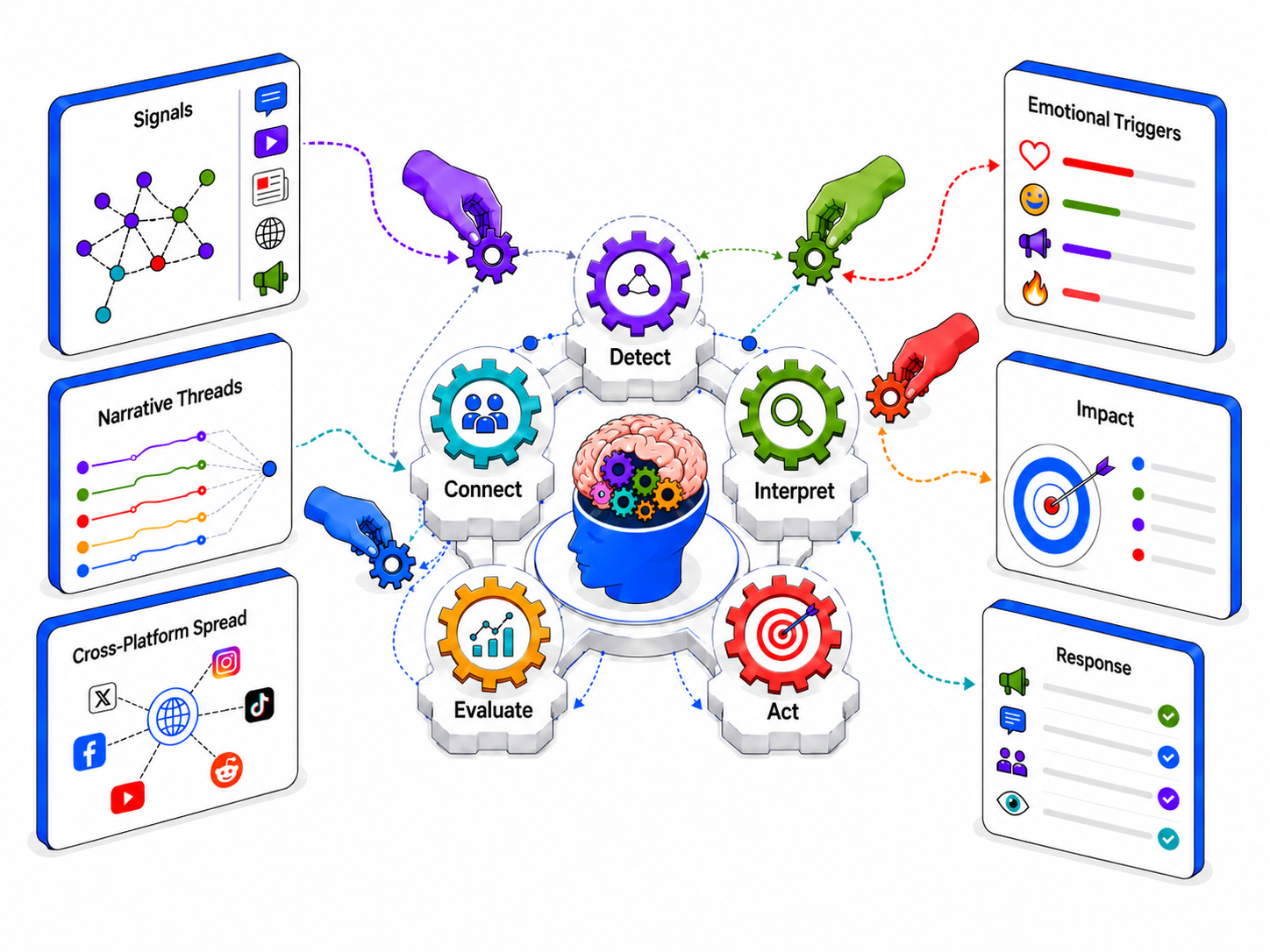
Most organisations can track mentions, sentiment, and coverage. Far fewer can explain which interpretation of events is gaining ground.
That gap matters. The EEAS documented 540 foreign information manipulation incidents in 2025, nearly half linked to elections, protests, or international crises. Narrative intelligence helps leaders see which claims are gaining traction, who amplifies them, and how they move across communities and platforms.
What Narrative Intelligence Means
Narrative intelligence is the discipline of analysing how interpretations of an issue form, spread and gain influence across the information environment. Where traditional monitoring counts units of content, it examines five interconnected layers:
Claims being made
Actors introducing and repeating them
Channels carrying them
Relationships between those actors and channels
Behavioural signals - timing, repetition, synchronisation - that reveal how a storyline is being pushed
For example, “a company is expanding a factory” is a topic. “The expansion will damage local water supplies, and officials are hiding the risk” is a narrative. It contains a cause, a consequence, and an implied villain.
Narrative intelligence therefore examines the claims, actors, channels, communities, and behavioural signals behind amplification. The result is not simply a map of conversation. It is a map of the narrative environment.
Disinformation analysis is part of this picture, but it does not define it. Many of the most consequential narratives an organisation faces are not false - they are selective framings, genuine grievances amplified out of proportion, or accurate facts arranged into a misleading story. A discipline built only to detect falsehoods would miss most of what moves opinion.
What Turns a Topic Into a Narrative?
A topic becomes a narrative when it gains a cause, a villain, and a consequence.
A topic is a subject area: energy prices, vaccine policy, a company's factory expansion.
A conversation is the volume of discussion around a topic, which is what social listening tools measure.
A message is a single unit of communication: one post, one article, one video.
A narrative is a recurring interpretive claim that connects events into a story with causes, villains, and consequences: "the factory expansion will poison the local water supply, and officials are covering it up."
A narrative frame tells audiences not just what happened but what it means and who is to blame. That is why narratives persist while individual messages disappear, and why the same narrative travels across platforms wearing different words. Narrative detection therefore cannot rely on keyword matching: the claim mutates, but the story stays recognisable.
What Goes Into the Analysis
Coverage determines what the analysis can see. Narrative intelligence draws on social platforms, video platforms, public messaging channels, online news, forums, and broadcast monitoring, because narratives do not respect platform boundaries. Messaging-app material comes from public channels and groups only. Private conversations stay out of scope.
Scale matters as much as breadth. A single national engagement can involve over a million items of content in several languages. Where public opinion is part of the question, media data can be paired with commissioned, nationally representative survey research, so the analysis captures what people actually believe as well as what circulates online.
Five Questions Narrative Intelligence Helps Answer
Narrative intelligence earns its place by answering five operational questions.
What Claim or Interpretation Is Taking Hold?
Clustering thousands of messages by meaning surfaces the claims that recur often enough to become shared explanations of events. Detecting a narrative while it is still limited to one community gives your organisation time to prepare before it spreads more widely.
Who Is Introducing and Amplifying It?
Origin and amplification are different roles. A fringe account seeds the narrative, a network of anonymous profiles amplifies it, and an influencer or minor outlet legitimises it. Mapping that chain shows who introduced the claim, who expanded its reach, and who made it credible.
How Is It Moving Between Channels and Communities?
Narratives migrate: from Telegram to TikTok, from diaspora forums to mainstream press. Cross-channel movement is one of the strongest indicators that a storyline is escalating. Video platforms increasingly carry that movement. The Reuters Institute found that 65% of respondents consumed news through social video.
Is It Gaining, Losing, or Changing Momentum?
Temporal analysis separates two patterns.
An organic burst decays within days.
A pushed claim keeps returning with new hooks.
Momentum, not volume, predicts which narratives will shape public perception.
Does the Amplification Show Signs of Coordination?
Synchronised posting times, copy-paste text variants, and accounts created in batches are behavioural fingerprints. They suggest an organised operation rather than grassroots discussion. Coordination does not prove state involvement, but it changes the risk calculus.
In 2025, where attribution was possible, 35% of manipulative content was linked to state actors: 29% to Russia and 6% to China (EEAS, 2026). Much of the activity, however, cannot be attributed with confidence. Both countries often operate through layered and opaque networks that expand a campaign's reach while obscuring direct responsibility.
What Narrative Intelligence Adds to Social Listening
Narrative intelligence reveals which claims are driving a reaction, who is amplifying them, and how they move across communities and platforms. Social listening and sentiment analysis, by contrast, show how much is being said and whether the tone is positive or negative.
Here's what that looks like in practice.
Social listening would have told the factory-expansion company that mentions rose 12% and sentiment dipped.
Narrative intelligence would have shown a contamination cover-up claim consolidating in two local Facebook groups. The accounts pushing it had a history of coordination, and the claim was just reaching a regional outlet.
The market is moving in this direction. Gartner forecasts that enterprise spending to combat misinformation and disinformation will exceed $30 billion by 2028. It also predicts that 45% of chief communications officers will adopt narrative intelligence technologies by 2029.
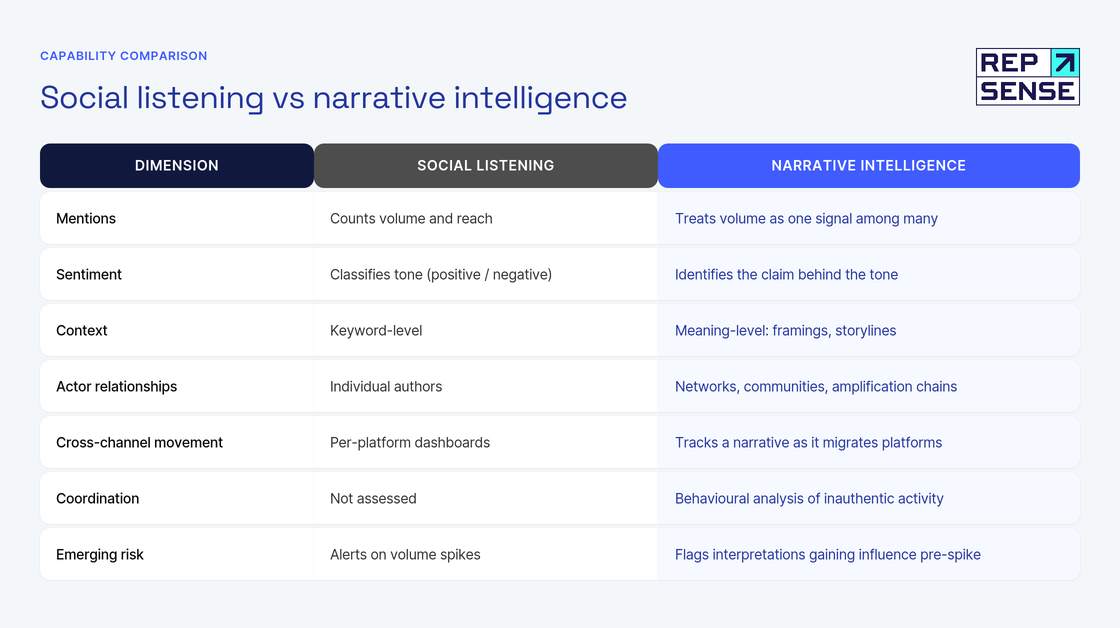
Comparison of social listening and narrative intelligence, showing how each approach analyzes online conversations and narratives
How Narratives Are Identified Across Large Data Sets
Narrative intelligence systems combine several methods to identify patterns across large and fragmented data sets.
Semantic clustering groups content by meaning, allowing differently phrased or multilingual claims to appear within the same narrative cluster.
Entity recognition identifies the people, organisations, places, and issues involved,
Temporal analysis shows when a narrative emerged, how quickly it spread, and whether it later resurfaced.
Network analysis maps relationships between accounts, channels, outlets, and communities, while source intelligence traces how narratives move between them.
During Armenia’s 2026 parliamentary election, Repsense analysed more than 1.2 million mentions across 12 platforms and tracked 24 election-related narratives between November 2025 and June 2026. By combining semantic, temporal, and network analysis, the research identified a coordinated cross-platform network moving narratives from Russian-language Telegram channels into Armenian TikTok audiences within hours. A nationally representative survey of 1,955 respondents provided an additional layer, allowing the media environment to be compared with public attitudes.
Human validation then turns these outputs into intelligence. The platform detects and structures signals; analysts assess their meaning, relevance, and potential impact. In the Armenian case, that meant identifying not only how narratives travelled, but also that 13 TikTok accounts linked to the network continued posting after the votes were counted. Volume metrics alone would not have revealed that pattern.
This human-in-the-loop approach is central to the responsible application of narrative intelligence. Machine learning and generative AI increase speed and scale, but human judgment connects the data to real-world decisions.
Narrative Intelligence in Disinformation and Cognitive Security
In the security domain, narratives are the payload of influence operations. Foreign information manipulation and interference (FIMI), disinformation campaigns, and what NATO calls cognitive warfare share one mechanism. They inject and amplify narratives designed to erode trust, polarise societies, or paralyse decision-making. We examine this in more depth in our guide to cognitive warfare in modern information wars.
Crucially, FIMI analysis is not limited to judging individual posts as true or false. The EU treats FIMI primarily as a pattern of behaviour, examining:
the infrastructure used, such as coordinated accounts, mirror sites, and content-laundering networks;
the methods of amplification, including synchronised posting and movement between platforms;
the timing and political context of the activity;
the intended effect on public debate or decision-making.
Even factually accurate content can therefore form part of an influence operation. What matters is the behaviour: a covert network promoting it at a strategically chosen moment.
This is why cognitive security, cybersecurity, and narrative intelligence increasingly share methods: all three defend infrastructure. The latter defends the infrastructure of meaning.
How Organisations Use Narrative Intelligence
The World Economic Forum ranked misinformation and disinformation as the leading short-term global risk for the second year running. Organisations respond to that risk in four main ways.
Detecting disinformation and influence operations: Governments, defence institutions, and election monitors use narrative intelligence to identify coordinated campaigns early and support attribution where evidence allows. The aim is to respond before a campaign reaches mainstream audiences.
Protecting institutions and public trust: Public bodies track narratives targeting their credibility so they can respond while correction is still possible. Research found that false news reached audiences about six times faster than accurate stories. It was also 70% more likely to be reshared.
Identifying reputational and commercial risk: Companies use narrative intelligence to assess activist campaigns, short-seller claims, product-safety rumours, and ESG narratives. The goal is to distinguish genuine backlash from coordinated amplification. Repsense applied this for a European wind-energy developer facing organised Facebook opposition to its Czech projects. Analysis of 5,139 posts and comments over 16 weeks clustered the discussion into 76 topic threads. What looked like scattered local opposition traced back to seven pages and groups forming a fully connected amplification core.
Evaluating strategic communication: Communications teams use it to see which framings audiences adopt, where messages fail to resonate, and how competing narratives respond.
A Practical Narrative Intelligence Strategy
Detection only matters if it leads somewhere. A workable narrative intelligence strategy moves through seven steps:
Define the issue: the entities, topics and regions that matter, precisely enough to be monitorable.
Collect cross-channel data: social platforms, news, forums, messaging apps; narratives do not respect platform boundaries.
Identify recurring claims: cluster content by meaning to surface candidate narratives.
Map actors and communities: who originates, who amplifies, which audiences are receptive.
Analyse spread and momentum: trajectory, cross-channel movement, resurgence patterns.
Assess coordination and risk: behavioural indicators, potential impact, proximity to key events.
Decide how to respond, if at all: sometimes pre-bunking, sometimes briefing stakeholders, often documented watchfulness. Responding can itself amplify.
What the Discipline Cannot Do
Narrative intelligence has limits worth stating.
Automated clustering produces false positives, and unrelated content can land in the same cluster. That is one reason human validation is built into the process.
Large-scale monitoring also invites a fair critique: that watching public discourse at scale can chill it. The discipline's answer is restraint. Repsense analyses publicly available information, not private communications, and operates in line with EU GDPR requirements.
Scale carries a cost, too. Monitoring millions of items across platforms and languages demands significant computing resources, so collection is designed for efficiency rather than volume.
These limitations do not reduce the value of narrative intelligence; they define the conditions under which it needs to be applied responsibly and effectively.
Why Earlier Context Leads to Better Decisions
Narrative intelligence does not promise prediction with certainty. Anyone selling that is overclaiming. What it delivers is earlier, structured context. You see how an issue is being framed while the framing is still forming. You get a clear picture of who is shaping public perception. And you get a grounded assessment of where a storyline may travel next.
That context turns monitoring from a rear-view mirror into actionable, real-time input for decision-making. Organisations that depend on mention counts and sentiment alone will often remain behind the narrative curve.
Those that build their narrative intelligence can understand their information environment more clearly and respond with greater precision.
The advantage is not being the loudest organisation in the conversation. It is understanding the narrative first.
FAQ
-
In academic research, “narrative intelligence” can refer to an AI system’s ability to understand and generate stories, a field linked to computational narratology. In applied systems, it describes AI used to group content by meaning, identify emerging narratives across languages, and flag unusual amplification for human review.
-
A large language model is a general-purpose technology for analysing and generating text. Narrative intelligence is an analytical discipline that may use LLMs as one component, alongside verified cross-platform data, source tracking, network analysis, behavioural signals, and human validation.
-
Yes, but its reliability depends on the language data available and the involvement of fluent speakers or community experts. AI can help group related content, identify recurring claims, and track amplification in Indigenous-language material (Tonja et al., 2024). However, it may miss culturally specific meanings, including humour, historical references, indirect blame, or symbolism. For this reason, findings should be validated by people who understand both the language and the relevant cultural context.
References
Allied Command Transformation. (2024, July 3). Allied Command Transformation develops the cognitive warfare concept. NATO. https://www.act.nato.int/article/cogwar-concept/
European External Action Service. (2026). 4th EEAS report on foreign information manipulation and interference threats. https://www.eeas.europa.eu/sites/default/files/2026/documents/EEAS%204th%20Threat%20Report_web%20version_1.pdf
Gartner. (2025, October 21). Gartner predicts enterprise spending on battling misinformation and disinformation will surpass $30 billion by 2028 [Press release]. https://www.gartner.com/en/newsroom/press-releases/2025-10-21-gartner-predicts-enterprise-spending-on-battling-misinformation-and-disinformation-will-surpass-30-billion-dollars-by-2028
Gartner. (2025, November). Predicts 2026: Top predictions to inform 2026 comms strategies. https://www.gartner.com/en/documents/7160430
Reuters Institute for the Study of Journalism. (2025). Digital News Report 2025. https://reutersinstitute.politics.ox.ac.uk/digital-news-report/2025
Tonja, A. L., Balouchzahi, F., Butt, S., Kolesnikova, O., Ceballos, H., Gelbukh, A., & Solorio, T. (2024). NLP progress in Indigenous Latin American languages. Proceedings of the 2024 Conference of the North American Chapter of the Association for Computational Linguistics: Human Language Technologies (Volume 1: Long Papers), 6972–6987. https://aclanthology.org/2024.naacl-long.385/
Vosoughi, S., Roy, D., & Aral, S. (2018). The spread of true and false news online. Science, 359(6380), 1146–1151. https://doi.org/10.1126/science.aap9559
World Economic Forum. (2025). Global Risks Report 2025. https://www.weforum.org/publications/global-risks-report-2025/