

What Is Disinformation and How It Spreads Across Media and Online Platforms
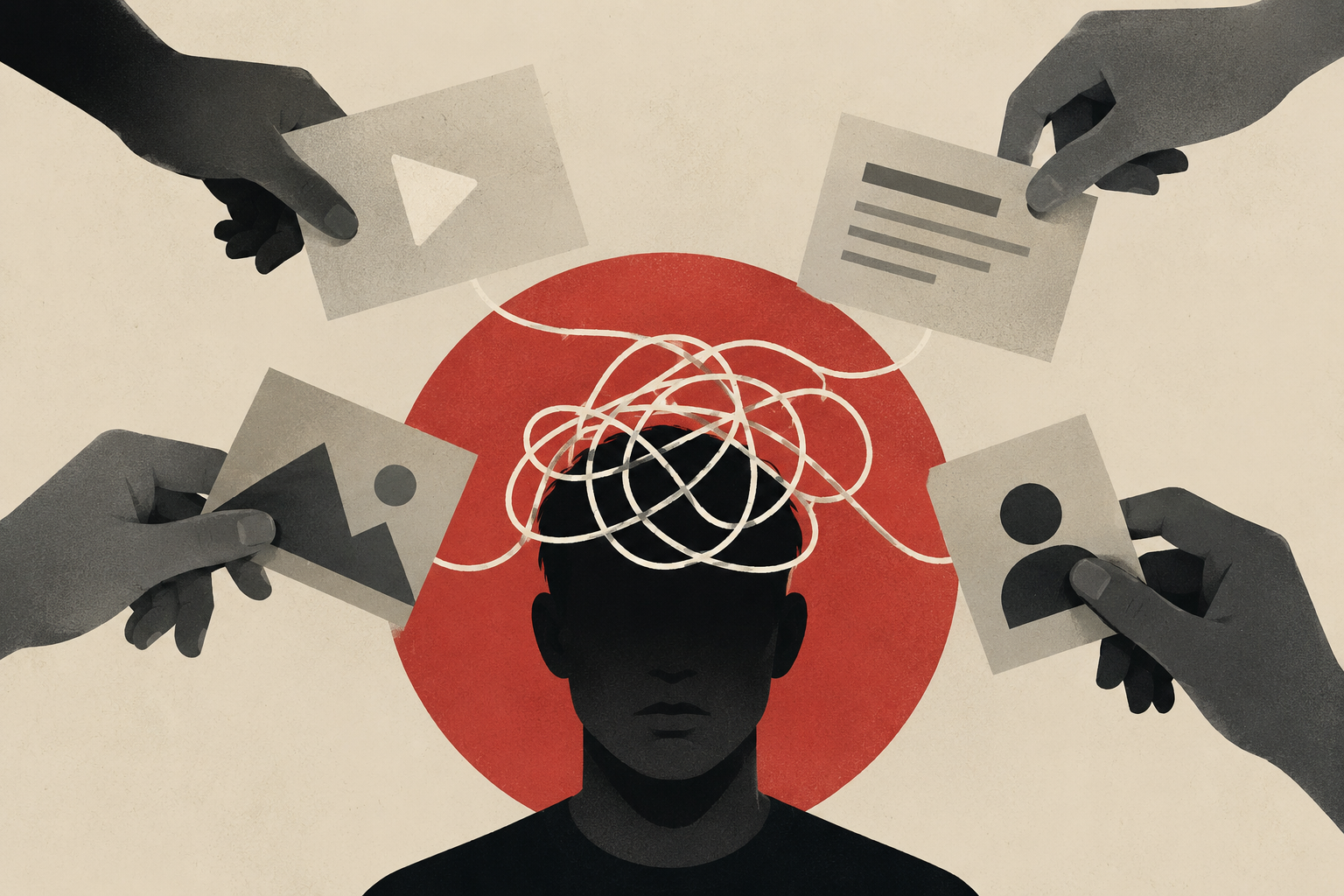
Today's information environment moves faster than ever. News, opinions, and narratives spread instantly across social media platforms, online news, podcasts, and video content. As a result, the line between truth and falsehood has become increasingly blurred.
What Is Disinformation?
Disinformation is false information shared to deceive. It aims to cause harm. Unlike misinformation, disinformation is intentional.
The key difference is intent. A person who shares an outdated article by accident spreads misinformation. A political operative who plants a fake story before an election spreads disinformation. The content may look identical, but the motive is not.
Information in the Digital Age
Information today is both a tool of empowerment and a tool of control.
Social movements use social media to organize and counter censorship, as the Arab Spring showed. Citizens in closed societies often turn to encrypted apps and global platforms to share news their governments suppress.
At the same time, authoritarian regimes restrict access to information through systems like China's "Great Firewall." Foreign actors also use disinformation and propaganda to influence public debate abroad, as Russian attempts to sway elections in Moldova have shown. The same tools that empower activists can also serve as weapons.
Why Is Disinformation Dangerous?
Disinformation weakens democracy by undermining trust in shared facts. As competing narratives spread online, public debate becomes more polarized and consensus harder to reach.
The COVID-19 pandemic showed these effects clearly. False claims about vaccines spread rapidly across social media and drove down vaccination uptake in some communities. Studies later found a strong correlation between higher vaccination rates and lower mortality. One multinational study showed that every 10-percentage-point increase in vaccination coverage correlated with an 18.1% decrease in mortality (Wu et al., 2023).
Researchers in Utah also found that respondents with the highest belief in vaccine myths had 99.9% lower odds of full vaccination compared to those with the lowest belief (Omisakin, 2023).
Common Forms of Disinformation
Disinformation rarely appears in one obvious form. It spreads across platforms and formats, blending into everyday media consumption.
Misleading Headlines
Many misleading news stories rely on emotionally charged headlines that maximize clicks. Users often share articles without reading beyond the headline, which lets distorted impressions spread rapidly.
Satirical or Parodic Content
Satire can unintentionally turn into misinformation when users mistake jokes for factual reporting. Once humorous content loses its original context, it may spread false claims as "real" information.
Deceptive Content
Deceptive content presents misleading claims as credible analysis. During the pandemic, some narratives described COVID-19 as exaggerated, promoted unverified treatments, or framed public health measures as more dangerous than the virus itself. These narratives looked logical and evidence-based, but they aimed to deceive audiences and undermine trust in science.
Content Shared in the Wrong Context
True information can mislead when it lacks context. Users may reshare old statistics, images, or political statements as evidence of current events, even when they have no connection to the situation. This overlap between disinformation and malinformation is increasingly common online.
Altered or Associative Images
Visual disinformation spreads quickly because emotional images attract attention on social media. Associative images use real visuals in misleading contexts - for example, reposting an old protest photo as evidence of current unrest. Rather than fabricating content, this tactic misleads through emotional association and selective framing.
Fake Branding and Impersonation
Some disinformation campaigns imitate trusted news organizations or institutions to increase credibility. A fabricated headline that resembles a legitimate news source can spread widely before users verify it.
Completely Fabricated Stories
Some disinformation is entirely invented. A well-known example is the "Pizzagate" conspiracy theory, which falsely claimed that a child trafficking operation ran out of a Washington restaurant. Although false, the narrative spread widely online and eventually caused real-world harm.
What Is Information Disorder?
Information disorder describes an environment in which the line between truth and falsehood grows increasingly unclear.
In these environments, misinformation and disinformation, fake news, propaganda, and emotionally charged narratives circulate at the same time. Users may share misleading content without harmful intent, while political actors and coordinated networks deliberately amplify deceptive narratives.
As narratives evolve rapidly online, understanding the spread of disinformation requires more than simple keyword tracking. It requires analysis of how narratives gain traction and influence audiences across digital ecosystems.
Misinformation vs Disinformation vs Fake News
These terms overlap, but they are not the same.
Misinformation is false content shared by mistake. Example: sharing an old news story as new.
Malinformation is true content used to cause harm. Example: leaking private data to ruin someone's reputation.
Disinformation is false content built to mislead on purpose. Example: a disinformation campaign aimed at voters before a vote.
Fake news is made-up content styled like real journalism. The term comes up in talks about social media platforms and polarization.
Why Is Disinformation Hard to Define?
Defining disinformation gets complicated because it raises fundamental questions about truth, authority, and freedom of expression.
Democratic societies rely on open debate and multiple perspectives. However, definitions that are too broad risk suppressing legitimate disagreement, while definitions that are too narrow may let harmful falsehoods spread unchecked.
This became especially visible during the pandemic, when debates over science, public health, and online moderation intensified. Civil society groups, fact-checking organizations, and researchers continue to push for clearer standards.
Efforts to counter disinformation require careful calibration between protecting open discourse and safeguarding factual information.
Final Thoughts
Disinformation is not just false content - it is a structural feature of today's information environment. It exploits the speed and emotional pull of digital platforms to shape perception and accelerate narrative spread.
As the line between truth and falsehood blurs (Monaci, 2023), the challenge is no longer only to spot what is accurate, but to understand how narratives are built and believed.
Countering disinformation takes more than reactive fact-checking. It needs critical thinking, institutional resilience, and tools that track evolving narratives in real time.
FAQ
-
No.
Disinformation is tactical and situational. It aims to achieve a short-term effect, such as swaying voters or sowing confusion during a crisis.
Propaganda is strategic and ideological. It uses true, distorted, or false information to promote a broader ideology over time.
In short, disinformation is a tool, while propaganda is a long-term system of influence.
-
Yes - AI can detect disinformation and misinformation by analyzing large datasets to identify patterns, anomalies, and coordinated behavior. It can flag suspicious accounts and track narrative spread faster than human teams alone.
Detection alone, however, is not enough. Disinformation relies on context and narrative dynamics that machines still struggle to read. The strongest results pair AI tools with human analysts and fact-checking expertise.
-
Repsense maps how narratives move across the web. It monitors online news, Telegram, TikTok, podcasts, and broadcast media. The platform pairs narrative intelligence with sentiment analysis and multimodal AI. So analysts can spot coordinated disinformation early. They also see how false stories jump from one platform to the next.
References
Monaci, S., & Sara Monaci. (2023). dominant Voices in the New Disinformation Order. In M. Filimowicz (Ed.), Information Disorder (1st ed., pp. 1–28). Routledge.
https://doi.org/10.4324/9781003299936-1
Omisakin, O. A., Ulrich-Schad, J. D., Hunt, A., Givens, J. E., & Beacham, M. (2023). Belief in vaccine myths and vaccine uptake in Utah during the COVID-19 pandemic.
Preventive Medicine Reports, 36, 102390.
https://doi.org/10.1016/j.pmedr.2023.102390
Stasiuk-Krajewska, K., Bąkowicz, K., & Wenzel, M. (2024). An Analysis of the Narratives of Right-Wing Populist Movements on Social Media in Relation to Vaccination and the
War in Ukraine (Grzegorz Rzeczkowski / Przemyslaw Witkowski / Roland Zarzycki).
In Disinformation (Vol. 19). Peter Lang GmbH, Internationaler Verlag der
Wissenschaften.