
What Is Cognitive Warfare in Modern Information Wars?

NATO STO (2025) considers human cognition as a strategic challenge
Wars were never limited to missiles, tanks, and troops on the ground. Rhetoricians in Ancient Greece understood that shaping perception could be as decisive as any battle (Henschke, 2025). What is unprecedented today is the technological infrastructure behind these timeless strategies. It allows them to scale globally in real time and target civilian populations as easily as military ones.
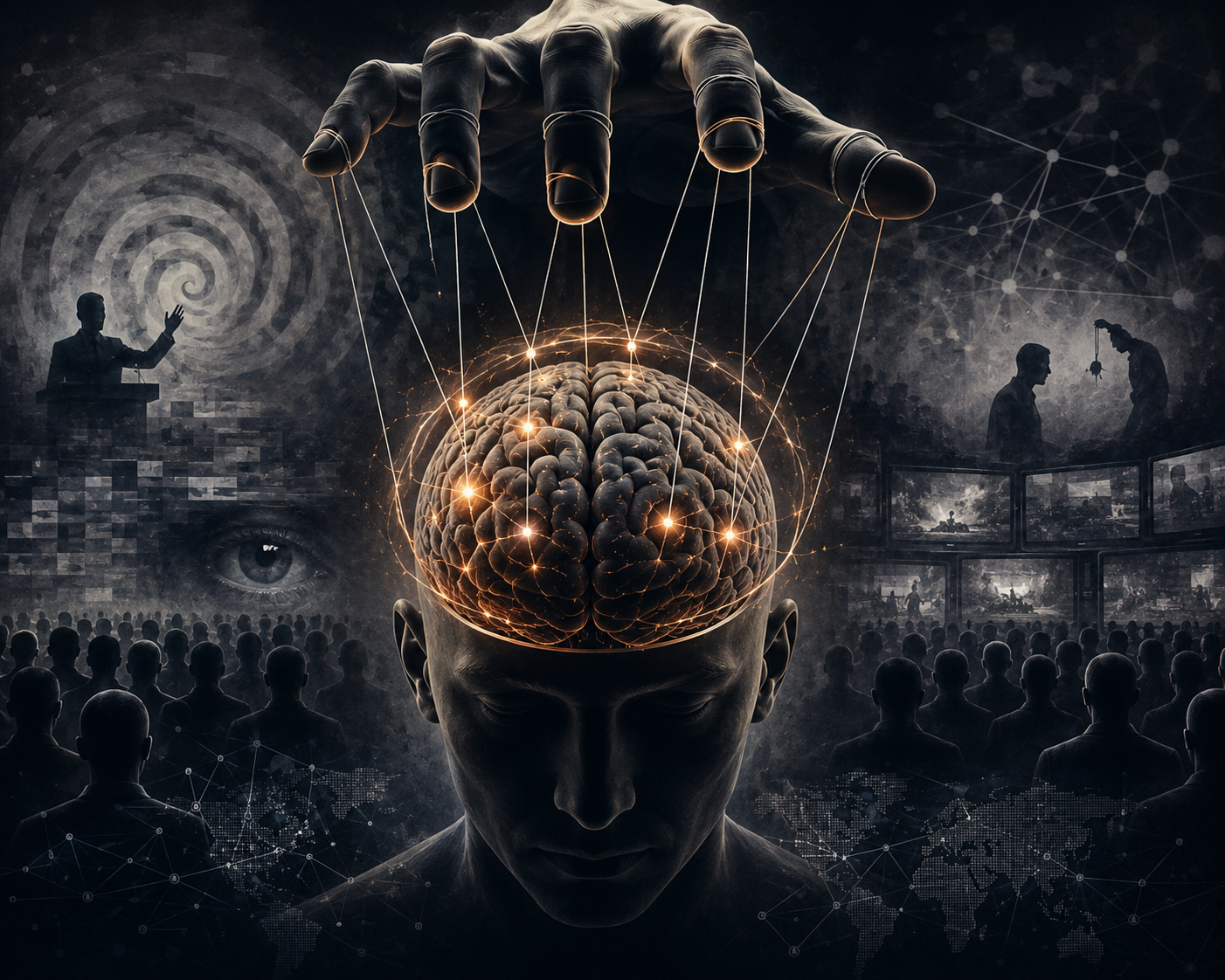
NATO recently published its Chief Scientist Research Report on Cognitive Warfare (Blatny, 2025). The report is a landmark document. It signals that the Alliance now treats the manipulation of human cognition as a strategic challenge. The challenge ranks alongside traditional military domains (Blatny, 2025). It reframes how Western institutions should think about the information environment, hybrid threats, and national security.
Against that backdrop, understanding what cognitive warfare actually is has never been more urgent. It also matters to see how it differs from older concepts like information warfare or psychological operations.
How Can We Define Cognitive Warfare Today?
To define cognitive warfare, we can describe it as the deliberate use of information, AI, and behavioural science to influence, undermine, or alter human decision-making at scale (Blatny, 2025).
It combines information warfare, AI, social media, cyber operations, psychological warfare, and behavioural science to shape human cognition and decision-making at scale (Blatny, 2025). In the digital age, the target is no longer only territory. It is trust, perception, and public opinion.
Under NATO's framework, the cognitive domain is not formally recognized alongside land, air, maritime, space, and cyber domains. But it is increasingly treated as a cross-cutting dimension within Multi-Domain Operations (MDO) (Blatny, 2025). Some analysts now refer to "cognitive domain operations" as a distinct category of activity.
Cognitive warfare goes beyond traditional InfoOps, PsyOps, STRATCOM, and cyber operations. It targets human cognition and behaviour across the wider information environment. Some NATO publications even propose cognition as a sixth or "Human Domain" of warfare (Claverie & du Cluzel, 2022). Together, "warfare and information" now form a single contested space.
Cognitive Warfare vs. Information Warfare
Cognitive warfare and information warfare both involve information operations. But they differ significantly in source and target.Information warfare refers to the use of information-related capabilities by military or state actors to influence adversarial decision-making and protect their own information environment (Blatny, 2025).
Cognitive warfare targets the human mind itself -including perception, emotion, reasoning, and behaviour (Henschke, 2025). Unlike traditional information warfare, its objective is often not persuasion alone. It seeks confusion, distrust, polarization, and the gradual erosion of a shared sense of reality. Adversaries use it to manipulate public opinion and degrade trust in democratic institutions.
Why Cognitive Warfare Matters in the Digital Age
The rise of digital platforms has dramatically accelerated the speed and scale of influence. Social media algorithms prioritize emotional engagement, short-form video dominates attention, and artificial intelligence can generate convincing synthetic content within seconds (Goldstein et al., 2023).
Narratives now spread across TikTok, Telegram, YouTube, and X in real time. Outrage spreads faster than nuance, while AI-powered manipulation can scale globally within minutes. This disruption of the information environment makes traditional defenses inadequate.
Who Uses Cognitive Warfare and Why?
Cognitive warfare is used by many actors. These include:
States
Intelligence actors
Political groups
Extremist networks
Cyber actors
Private influence networks
They seek strategic advantage without direct military confrontation, operating in the blurred space between war and peace, influence and interference (Blatny, 2025).
While liberal democracies may frame certain values as universal, virtually all states engage in efforts to shape perceptions and behaviour abroad through strategic communication and information operations (Henschke, 2025).
Objectives Below the Threshold of War
The objectives of cognitive warfare may include:
Influencing elections
Weakening democratic trust
Increasing polarization
Undermining military morale
Destabilizing societies
According to NATO, some adversaries already operate continuously below the threshold of conventional war (Blatny, 2025). The goal is often not immediate victory but gradual erosion. Adversaries seek to degrade trust, social cohesion, and institutional legitimacy. In the end, they erode a shared sense of reality itself.
Cognitive Warfare in Hybrid Warfare
Cognitive warfare is a central part of modern hybrid warfare, which combines military and non-military tools to achieve strategic goals without direct large-scale confrontation (Blatny, 2025).
The international system exists in a state of strategic competition rather than permanent peace. Operating in the "grey zone" between war and peace, hybrid warfare reduces the costs of open conflict while targeting human "grey matter" itself - perceptions, emotions, beliefs, and decision-making (Henschke, 2025). Cognitive warfare could shape outcomes long before any kinetic engagement begins.
As a result, distinctions between legal influence and illegal interference, as well as civilian and military action, become blurred.
The May 2026 Vilnius Drone Alert
The May 2026 Vilnius drone alert shows this in action. On 20 May 2026, Lithuania's defence ministry sent an air raid alert to mobile phones after a drone was spotted near the Belarus border. The president, prime minister, and MPs were taken to shelters - a first for an EU and NATO capital since 2022. Vilnius airport closed and NATO air policing was activated.
The kinetic event lasted about an hour. The cognitive event lasted much longer. Repsense narrative intelligence research tracked how a single official announcement split across Facebook, Telegram, and TikTok into parallel streams of news, satire, civic criticism, and disinformation within hours - turning the information environment itself into a contested battlefield. Read the full report here.
The Hybrid Toolkit
Modern hybrid warfare combines kinetic confrontation with cyber attacks, disinformation, economic coercion, political interference, AI-generated propaganda, and coordinated influence operations. The aim is to shape public perception and weaken societal resilience below the threshold of armed conflict (Blatny, 2025).
Geopolitical competition now revolves around narrative dominance, strategic communication, and cognitive superiority. This makes cognitive warfare a defining feature of the digital age (DFRLab, 2024).
The Role of Social Media in Cognitive Warfare
Social media acts as one of the most powerful enablers of cognitive warfare. Platforms build their systems to capture and hold attention, drive emotional reaction, and reward virality. These conditions are ideal for outrage, sensationalism, conspiracy theories, and emotionally charged narratives.
NATO specifically identifies modern technologies and connectedness as force multipliers. They accelerate cognitive effects across society (Blatny, 2025).
Short-Form Video and Audiovisual Immersion
Short-form video platforms such as TikTok, Instagram Reels, and YouTube Shorts are especially influential. They merge emotion, speed, visual storytelling, music, identity, and algorithmic amplification.
Viewers no longer just read narratives. They experience them emotionally through audiovisual immersion. This makes the content far more memorable and far harder to fact-check in real time (Yarchi, Baden, & Kligler-Vilenchik, 2021).
How Algorithms Amplify Cognitive Warfare
Algorithms are not neutral. Platforms reward content that keeps users emotionally engaged (Milli et al., 2023). As a result, fear spreads faster, anger travels further, and divisive narratives gain more visibility than balanced reporting. Adversaries understand these dynamics and deliberately design content to exploit them.
Insights from cognitive science show how predictable human bias becomes when paired with these dynamics:
Confirmation bias keeps users inside their own filter bubbles (Pariser, 2011).
Negativity bias makes alarming content more memorable (Soroka, Fournier, & Nir, 2019).
In-group bias pushes audiences toward tribal interpretations of ambiguous events.
Adversarial influence operations exploit each of these systematically rather than by accident.
How AI Accelerates Cognitive Warfare
AI further accelerates this process. It does so through automated content generation, bot amplification, deepfakes, synthetic personas, and microtargeted messaging (Goldstein et al., 2023).
This creates an information environment where AI-powered manipulation spreads quickly and adapts constantly. The line between organic discourse and coordinated influence becomes harder to draw with each technological leap.
What Is Narrative Intelligence and How Does It Counter Cognitive Warfare?
Understanding how cognitive warfare works is the first step to defending against it. Traditional media monitoring is no longer enough. Counting mentions or tracking keywords cannot capture how narratives form, mutate, and spread across platforms. This is where AI-powered narrative intelligence becomes essential.
Narrative intelligence focuses on:
Detecting emerging narratives
Mapping influence networks
Identifying coordinated amplification
Understanding emotional dynamics
Predicting narrative escalation before crises emerge
Rather than tracking only surface signals, it analyzes:
Context
Narrative trajectories
Emotional framing
Behavioural signals
Cross-platform spread
From Monitoring to Multimodal AI Intelligence
Modern narrative intelligence platforms like Repsense use multimodal AI to monitor social media, broadcast media, podcasts, short-form video, and online news in real time.
The capabilities include AI-powered sentiment analysis, narrative clustering, native video analysis, speech-to-text transcription, and cross-platform influence detection.
Why Narrative Intelligence Matters Now
Narrative intelligence helps organizations:
Identify emerging cognitive threats
Detect coordinated disinformation campaigns
Build strategic foresight
Strengthen resilience within the modern information environment
Narratives now move faster than institutional response cycles. Predictive narrative analysis powered by AI becomes critical. Both governments and enterprises need it to protect national security, democratic stability, institutional credibility, and public trust.
How Cognitive Warfare Harms Individuals and Societies
Adversaries seek to influence human cognition and behaviour. The goal is a strategic advantage across multiple levels of society.
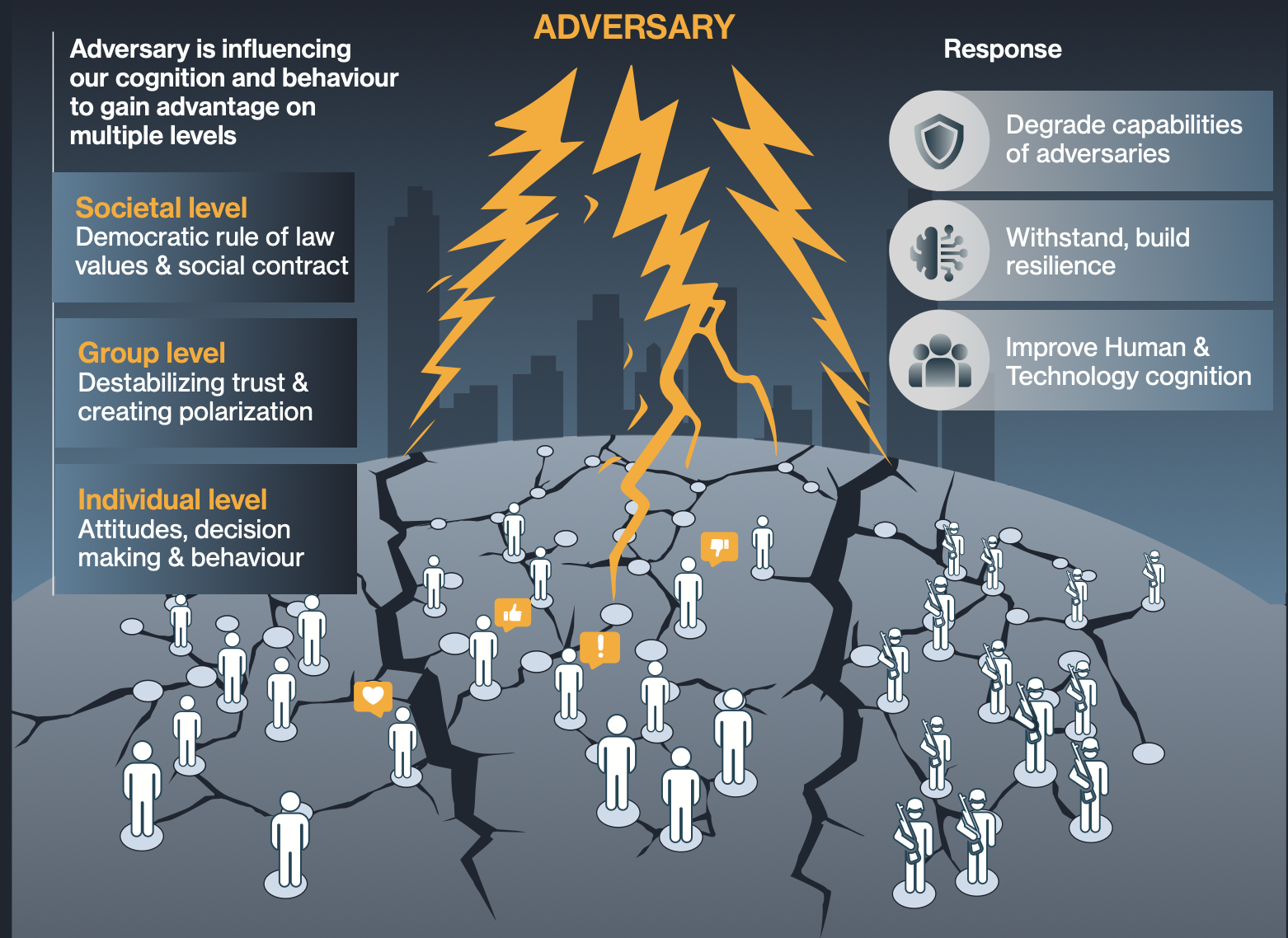
Blatny Janet M., Søndergaard Steen: Cognitive Warfare, 2025.
Effects at the Individual Level
At the individual level, adversaries shape attitudes, decision-making, emotions, and behaviour. They use emotional manipulation, disinformation, and AI-driven algorithmic amplification (Blatny, 2025). Each citizen becomes a potential entry point for adversarial influence.
Effects at the Group Level
At the group level, influence operations aim to destabilize trust and deepen polarization. They weaken social cohesion and intensify social fragmentation. These operations divide communities and redirect attention away from the adversary itself (Blatny, 2025).
Effects at the Societal Level
At the societal level, the target becomes the democratic social contract itself. The damage erodes confidence in institutions, democratic values, media, and the rule of law (Henschke, 2025). Cognitive warfare affects not only military environments. It also touches democratic systems, elections, public health, social stability, national security, and broader geopolitical security.
Examples of Cognitive Warfare: the War in Ukraine
Examples of cognitive warfare include election interference, coordinated disinformation campaigns, deepfake political content, AI-generated propaganda, conspiracy amplification, and psychological influence operations.
The Russia-Ukraine war is perhaps the clearest contemporary example. Cognitive warfare operates alongside kinetic conflict. Long before the full-scale invasion in 2022, Russia used conflicting narratives, false flags, and historical revisionism to destabilize Ukraine and shape public opinion across Europe (EUvsDisinfo, 2022).
As NATO notes, the war is fought not only through material attrition, but also through the human mind via digital information technologies (Blatny, 2025).
Conclusion
Cognitive warfare is no longer theoretical - it is an operational reality of the digital age. Modern conflicts are fought not only on physical battlefields, but also through narratives, algorithms, and human cognition. AI-generated content, deepfakes, and coordinated influence operations now spread faster than institutions can respond. They target not only governments and militaries, but society's shared sense of reality itself.
Defending against cognitive warfare requires more than awareness. It demands narrative intelligence, cross-platform monitoring, predictive analysis, and stronger democratic resilience. Organizations that understand how narratives emerge and spread will be better positioned to detect manipulation early and respond before crises escalate.
FAQ
-
Psychological warfare (PsyOps) uses propaganda, persuasion, fear, and morale manipulation to influence specific audiences and achieve military or political objectives (Blatny, 2025; Henschke, 2025).
Cognitive warfare is broader. It combines PsyOps with AI, social media algorithms, cyber operations, behavioural science, and narrative manipulation to shape how societies perceive and interpret information.
Unlike traditional PsyOps, cognitive warfare operates continuously across the digital information environment, often below the threshold of armed conflict.
-
Cognitive warfare uses a combination of disinformation campaigns, propaganda, AI-generated content, deepfakes, cyber operations, social media manipulation, algorithmic amplification, psychological operations, narrative engineering, bots and coordinated inauthentic behaviour, behavioural targeting, and strategic communication.
Emerging technologies act as force multipliers within cognitive operations. These include artificial intelligence, big data, and neurotechnology (NATO STO, 2024).
References
Blatny, J. M. (2025). Cognitive warfare (Chief Scientist Research Report). NATO Science and Technology Organization. https://www.sto.nato.int/document/cognitive-warfare/
Claverie, B., & du Cluzel, F. (2022). Cognitive Warfare: The Advent of the Concept of "Cognitics" in the Field of Warfare. NATO Innovation Hub.
DFRLab (Atlantic Council Digital Forensic Research Lab). (2024). Foreign Interference Attribution Tracker (FIAT) 2024. Atlantic Council. https://dfrlab.org/2024/10/23/dfrlab-launches-fiat-2024/
EUvsDisinfo. (2022). Disinformation cases tracking Russian narratives on Ukraine. European External Action Service.
Goldstein, J. A., Sastry, G., Musser, M., DiResta, R., Gentzel, M., & Sedova, K. (2023). Generative Language Models and Automated Influence Operations: Emerging Threats and Potential Mitigations. Stanford Internet Observatory / OpenAI / Georgetown CSET.
The Guardian. (2026, May 20). Lithuania’s leaders sent to bunkers after drone alert near Vilnius. The Guardian. The Guardian article
Henschke, A. (2025). Cognitive warfare: Grey matters in contemporary political conflict. Routledge. https://doi.org/10.4324/9781003487777
Milli, S., Belli, L., et al. (2023). Engagement, user satisfaction, and the amplification of divisive content on social media. arXiv:2305.16941.
Pariser, E. (2011). The Filter Bubble: What the Internet Is Hiding from You. Penguin Press.
Soroka, S., Fournier, P., & Nir, L. (2019). Cross-national evidence of a negativity bias in psychophysiological reactions to news. Proceedings of the National Academy of Sciences (PNAS), 116(38), 18888–18892.
Yarchi, M., Baden, C., & Kligler-Vilenchik, N. (2021). Political polarization on the digital sphere: A cross-platform, over-time analysis of interactional, positional, and affective polarization on social media. Political Communication, 38(1–2), 98–139.