
Turning Chaos into Signals: Data Ingestion in Cross-Media Monitoring

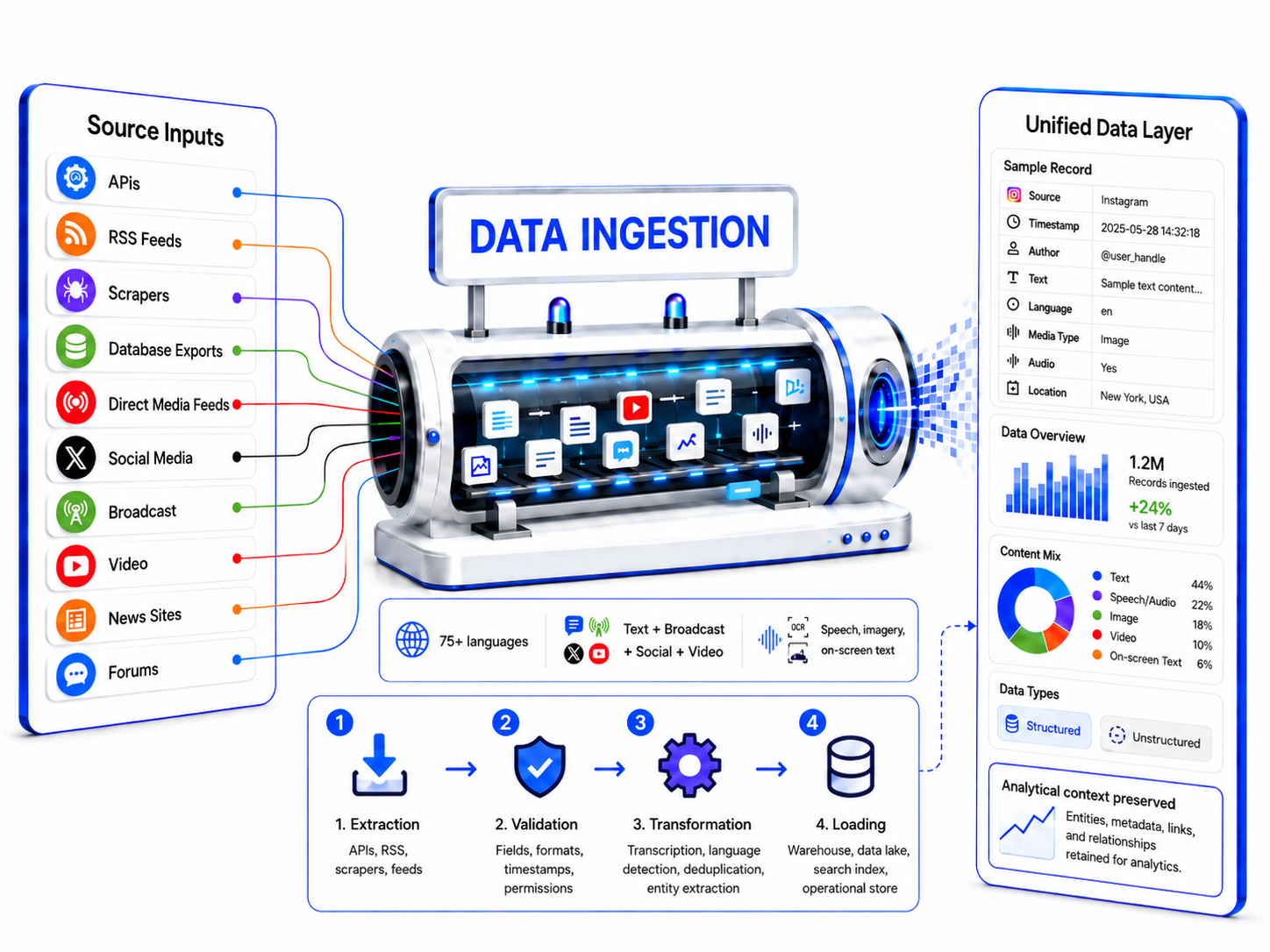
Four-stage data ingestion pipeline diagram: extraction, validation, transformation, loading
Newsrooms, brands, and government agencies now monitor more media content than any team can review manually. The information they need may sit in a social post, a TV segment, or a forum discussion. Data ingestion pulls that information into a system where it can be stored, processed, and analysed.
What Is Data Ingestion?
Data ingestion is the process of collecting raw data from multiple sources and moving it into a data warehouse, data lake, or another storage system.
The speed and quality of this process can determine whether a team detects a threat within minutes or misses it for days. Effective media monitoringdepends on timely collection, broad coverage, and reliable data.
In cross-media monitoring, data comes from:
● news sites,
● social platforms,
● broadcast transcripts,
● podcasts,
● forums, and
● video platforms.
Each source uses different formats and access methods.
A strong data ingestion tool handles both structured and unstructured data while preserving the source, timestamp, author, and context required for analysis.
Why Does Data Ingestion Matter?
Data ingestion matters because it helps teams prioritise high-value information, connect fragmented data across platforms, automate collection at scale, and improve the quality of downstream analytics.
In media monitoring, these capabilities determine whether analysts can identify an emerging threat quickly and trace how it spreads. They also decide whether analysts base their conclusions on complete and reliable evidence.
Helps Prioritise the Most Valuable Data
Data ingestion helps prioritise valuable data by tagging incoming records at collection and routing high-value streams to analysts first. A breaking broadcast, a cluster of near-identical posts, or a fast-growing video narrative reaches the team before routine coverage does.
At big data scale, manual data collection cannot separate signal from filler quickly enough.
Eliminates Isolated Data Pockets
A narrative may begin in a fringe forum, move into social media, appear in short-form video, and later reach mainstream news. If each platform remains a separate data store, teams see only fragments.
Data integration brings data from multiple sources into one searchable environment, helping analysts trace how a claim changes across platforms.
Powered and Sped Up by Automation
Automated ingestion processes collect data continuously, schedule batch ingestion, retry failed requests, and flag missing records. This frees data engineers to focus on data transformation, reliability, and analysis.
Elevates the Quality of Analytics
Data quality checks can catch duplicates, malformed timestamps, missing fields, and unexpected data types before they affect downstream data analytics.
Data ingestion is essential because machine learning cannot compensate for evidence that was never collected.
Inside the Data Ingestion Pipeline
A data ingestion pipeline usually moves data through four stages:
Extraction: data extraction tools collect material through APIs, RSS feeds, scrapers, database exports, and direct media feeds.
Validation: the pipeline checks required fields, data formats, timestamps, permissions, and schema rules.
Transformation: the pipeline cleans and standardises raw data through transcription, language detection, deduplication, and entity extraction.
Loading: the pipeline loads transformed data into a data warehouse, data lake, search index, or operational data store.
For Repsense, source variety is a practical engineering challenge. The Havel platform runs continuous collection across millions of sources in 75+ languages, covering text, broadcast, social media, and video. Its ingestion layer connects written content with speech, imagery, and on-screen text while preserving analytical context.
Repsense's published work documents this scale. For the Armenia 2026 election study, the pipeline ingested 21,561 TikTok videos from 678 monitored accounts. The transformation stage converted each video into analysable text: speech-to-text, computer vision classification, and on-screen text recognition. Narrative validation then matched 6.42 million sentences against twelve FIMI narrative pairs at a semantic similarity threshold of 85%.
Main Data Ingestion Methods
The right ingestion method depends on data volume, urgency, source behaviour, and the cost of delay.
Most ingestion stacks combine a few tool categories:
event streaming platforms and message brokers that move records between systems,
batch and workflow orchestrators that run scheduled jobs,
managed connector services that handle API-based sources,
change data capture tools that track database updates,
validation or observability layers that watch data quality.
The methods below describe how these tools are put to work.
Ingesting Data in Real Time
Real-time data ingestion moves information into the target system almost immediately, typically within a few seconds.
It works best when delay changes the decision, such as emergency alerts, breaking news wires, or coordinated posting spikes. It also carries the highest infrastructure cost of the main methods, because it requires always-on services, monitoring, redundancy, and rapid incident response.
Research on large-scale data processing frames this as a structural trade-off.No system can fully optimise correctness, latency, and cost at once. Teams pay for lower latency with computing resources or completeness (Akidau et al., 2015, Proceedings of the VLDB Endowment).
The cost can be justified. In 2024, the Havel platform detected a coordinated FIMI campaign targeting the planned military base in the town of Kapčiamiestis town in Lithuania’s Suwalki Gap. Content volume was still too low to trigger a volume-based alert. The coordination pattern gave it away: near-identical content seeded across Telegram channels and repackaged as TikTok videos in two languages. Continuous collection surfaced that pattern three days before broader social amplification and two weeks before mainstream media coverage.
Processing Data Streams in Motion
Streaming ingestion processes data continuously as it arrives, allowing teams to filter, enrich, and route records in near real time.
Platforms such as Apache Kafka move high-volume data between sources, storage, and analytics systems. Streaming pipelines must also handle late, duplicate, or out-of-order records while balancing accuracy, speed, and cost.
The trade-off is that faster processing may produce less complete results, while greater accuracy requires more time and computing resources.
Ingestion With Small Data Batches
Batch ingestion collects data on a schedule. Micro-batches may run every few minutes, while traditional jobs may run hourly or daily.
This method has a lower infrastructure cost and simpler setup. It suits historical data, podcasts, archives, and rate-limited sources. The YouTube Data API assigns quota costs to requests, while Reddit's Data API terms set access and usage conditions. Scheduled collection may therefore be more practical than constant requests.
The trade-off is freshness. An hourly job can leave analysts almost an hour behind.
Using Lambda Architecture for Ingestion
Lambda architecture combines a fast streaming path with a slower batch path.
The speed layer produces an early result.
The batch layer later reprocesses the full dataset and corrects late, missing, or duplicated records.
Its operational cost is easy to underestimate. Jay Kreps, co-creator of Apache Kafka, made this argument in 2014. His critique "Questioning the Lambda Architecture" targeted the dual-path design. Keeping the same logic in sync across two systems, he argued, is among the hardest jobs in data engineering.
Two paths can mean duplicate business logic, separate testing and deployment, and an added reconciliation layer. Teams may need to introduce schema changes twice, and a bug can affect one path but not the other.
The critique still holds a decade later. A February 2026 analysis from Materialize describes the same burden: duplicated implementations, doubled infrastructure, and results that can diverge between layers.
Lambda architecture fits high-stakes workflows where immediate insight has clear value and later accuracy remains essential. For many teams, frequent micro-batches or replayable streaming offer a better balance.
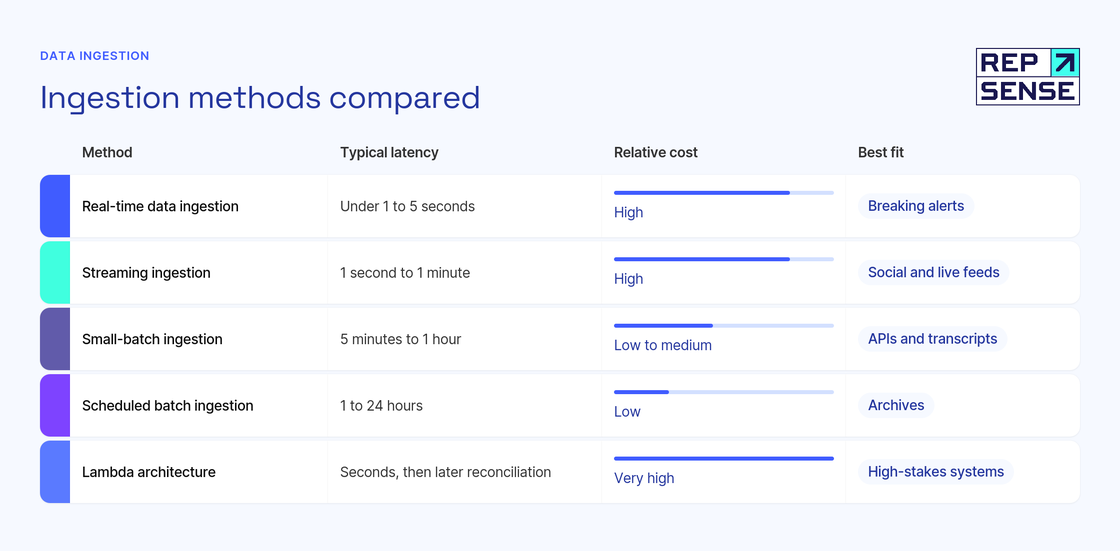
Data Ingestion Methods Compared: Latency, Cost and Best Use Cases
Benefits of Data Ingestion
● Faster decisions: Teams act on fresh information.
● Better machine learning inputs: Clean data supports more reliable models.
● Lower storage costs: Deduplicated, transformed data can reduce repeated storage.
● Broader visibility: Data from various sources creates a fuller picture.
● Scalable analysis: A modern data ingestion pipeline can absorb sudden volume spikes.
Challenges of Data Ingestion
Four challenges appear in almost every cross-media ingestion project: scale, network reliability, data quality, and security.
Scale
A pipeline designed for normal traffic can fail when a story goes viral. Scalable ingestion needs:
● queues,
● partitioning,
● automated scaling,
● rules for prioritising critical data.
Network Reliability
APIs fail, credentials expire, and platforms change their schemas or access limits. Reliable ingestion processes need retry logic, connector monitoring, and records of collection gaps.
Data Quality
Sources use different identifiers, timestamp formats, naming conventions, and data types. Records may arrive incomplete, mislabelled, or edited after collection.
Validation should preserve the original raw data alongside normalised fields and maintain data lineage, giving analysts a route back to the source.
Security
Cross-media monitoring can include sensitive data such as usernames, location metadata, political opinions, or personal details inside comments.
A data ingestion framework should include:
● role-based access,
● encryption,
● retention rules,
● audit logs,
● data minimisation.
The NIST Privacy Framework provides a structured approach to privacy risk. Its 1.1 update, drafted in 2025, adds a section on AI and privacy risk.
This is where Repsense built its ingestion layer differently. Havel ingests data from fringe forums, social media, broadcast and TV transcripts, and video platforms such as TikTok, YouTube, and Reels. It validates and enriches that data before it reaches an analyst, allowing teams to focus on interpreting narratives rather than cleaning spreadsheets.
How Do Data Ingestion Frameworks Support Better Business Decisions?
A data ingestion framework brings scattered data into one reliable system. Marketing, communications, security, and policy teams can compare the same validated signals.
The value is not simply collecting more data.
● Real-time ingestion supports early warning.
● Batch ingestion creates historical context.
● Streaming data shows movement as it happens.
● Data integration reveals how narratives travel across platforms.
Data Governance and Its Role in Maintaining Data Quality
Data governance defines who owns the data pipeline, who can access sensitive data, how long raw data remains in storage, and which records need additional review. It should also cover data lineage, quality thresholds, schema versioning, and audit trails.
Governance supports change data capture, which records updates as events instead of overwriting the previous version.
For narrative analysis, this history matters. An edited headline, corrected transcript, or deleted post can become part of the story.
Key Takeaways
Data ingestion turns raw data into usable signals. The strongest ingestion processes match latency to the decision window, combine real-time and batch methods, enforce data quality from extraction onward, and remain flexible as sources evolve.
Get the ingestion layer right, and every dashboard, report, data analytics workflow, and machine learning model built on top of it becomes more reliable.
FAQ
-
Start with data volume, source variety, speed requirements, and access restrictions. A small monitoring operation may need only scheduled batch ingestion. Cross-media monitoring requires a framework that can handle historical data, real-time data, cloud data, and structured and unstructured data.
-
No. Data ingestion moves data into a system. ETL means extract, transform, and load. Every ETL process includes ingestion, but not every ingestion process includes full transformation.
-
Use connectors for the required data sources, then configure streaming pipelines, scheduled batch jobs, or both. Add validation, retry rules, monitoring, deduplication, and alerts for missing records.
Automation still requires oversight. Data engineers need to maintain connectors, test schema changes, and ensure data remains compliant with access, security, and retention rules.
References
Akidau, T., Bradshaw, R., Chambers, C., Chernyak, S., Fernández-Moctezuma, R. J., Lax, R., McVeety, S., Mills, D., Perry, F., Schmidt, E., & Whittle, S. (2015). The dataflow model: A practical approach to balancing correctness, latency, and cost in massive-scale, unbounded, out-of-order data processing. Proceedings of the VLDB Endowment, 8(12), 1792–1803. https://doi.org/10.14778/2824032.2824076
Kreps, J. (2014, July 2). Questioning the lambda architecture. O'Reilly Radar. https://www.oreilly.com/radar/questioning-the-lambda-architecture/
Materialize. (2026, February 8). Does Kappa architecture improve on Lambda? https://materialize.com/blog/does-kappa-architecture-improve-on-lambda/
National Institute of Standards and Technology. (2025). NIST privacy framework 1.1 (Initial public draft; NIST CSWP 40). https://csrc.nist.gov/pubs/cswp/40/nist-privacy-framework-11/ipd