

PESO Model vs NIIS Model: What PESO Measures and What NIIS Adds

PESO model vs NIIS model: communications output on one side, measurement of audience response, search and AI answers on the other
The PESO model has organised communications planning for over a decade. It tells you where a message went and who controlled the channel – and nothing about what the audience did next: whether anyone remembered, searched, or found something worse.
What Is the PESO Model?
The PESO Model® organises communications activity into four media types: paid, earned, shared and owned media. It replaced the ATL/BTL split once digital media broke the line: audiences meet a brand across search results, social feeds and news sites; communicators needed one framework for their media strategies.
Who Created the PESO Model? Gini Dietrich and a Contested Origin
The PESO Model® was created by Gini Dietrich and introduced in 2014 in her book Spin Sucks. Dietrich is the founder of Spin Sucks and ran the process at her agency Arment Dietrich for years before publishing the cloverleaf diagram in a June 2013 blog post. The PESO Model® is a registered trademark of Spin Sucks.
The origin is more contested than most articles acknowledge. The late measurement expert Don Bartholomew used the term "PESO model" in a May 2010 blog post. Dietrich's company holds the trademark and states it acquired the rights before the book, citing material from 2010.
Before PESO: ATL and BTL Marketing
Procter & Gamble first used the ATL/BTL split in 1954, paying ad agencies separately from direct-marketing suppliers. ATL (above the line) covered paid mass media: TV, radio, print and outdoor. BTL (below the line) covered direct marketing: mailings, coupons, merchandising. The distinction collapsed once PR and digital advertising blurred the line.
The Four Media Types of the PESO Framework in Today's Media Landscape
PESO frames media as four distinct types. These different forms of media differ on two questions: who controls the channel and who pays for attention. Paid and owned sit under the brand's control; earned and shared belong to third parties.
Paid Media: Google Ads, Social Media Ads and Reach You Pay For
Paid media is everything a brand buys attention for: Google Ads, social media ads, sponsored content and paid influencer placements. Its strengths: speed, precise targeting, the power to reach new audiences. Its weakness: attention stops the moment spend stops.
Earned Media: Securing Third-Party Coverage
Earned media is coverage someone else chose to give: media coverage, media relations, thought leadership, influencer relations, sponsorships and partnerships. A third party vouches for the message, making it the most credible type of media – and the hardest to secure and attribute: press releases no longer guarantee pickup; the teams that win coverage build relationships with journalists.
Shared Media: Organic Reach and Third-Party Proof
Shared media is organic social activity: LinkedIn posts, TikTok videos, reviews and comments. Social media platforms throttle organic reach, so shared media rarely distributes. It works as proof: when you encourage customers to share their experiences on social media, or readers share your content, that user-generated content is the evidence prospects, journalists and AI systems check.
Owned Media: Building Strong Owned Content Assets
Owned media covers the owned channels a brand controls: the website, blog, content marketing, webinars, podcasts, email marketing and newsletters. Strong owned content goes deep, stays current and stays discoverable through search engine optimisation (SEO).
Why Marketers and Communicators Use the PESO Model
PESO earns its place for three reasons: it carries one message across four media channels rather than relying on just one. It clarifies budgets and team structure: every activity maps to one category across the organisation, and it gives marketing professionals and communicators a shared vocabulary to brief against.
The PESO Model® for Integrated Marketing and Public Relations
Before PESO, the world of public relations and marketing ran on separate models: PR counted clippings; marketing counted reach. PESO joined the two into one marketing communication plan; PR teams adopted it fastest because it gave earned media a defined seat in budget conversations.
PESO in Practice: The OESP Sequence to Amplify Campaigns
OESP reorders the four types into a campaign sequence: start with owned media, move to earned coverage, amplify through shared networks, and pay last, once cheaper channels have earned credibility. Earned and shared activity also test paid messaging before it costs ad budget.
PESO, original or as OESP, became a default way to plan content, campaigns, budgets and contractors, and even to structure communications departments.
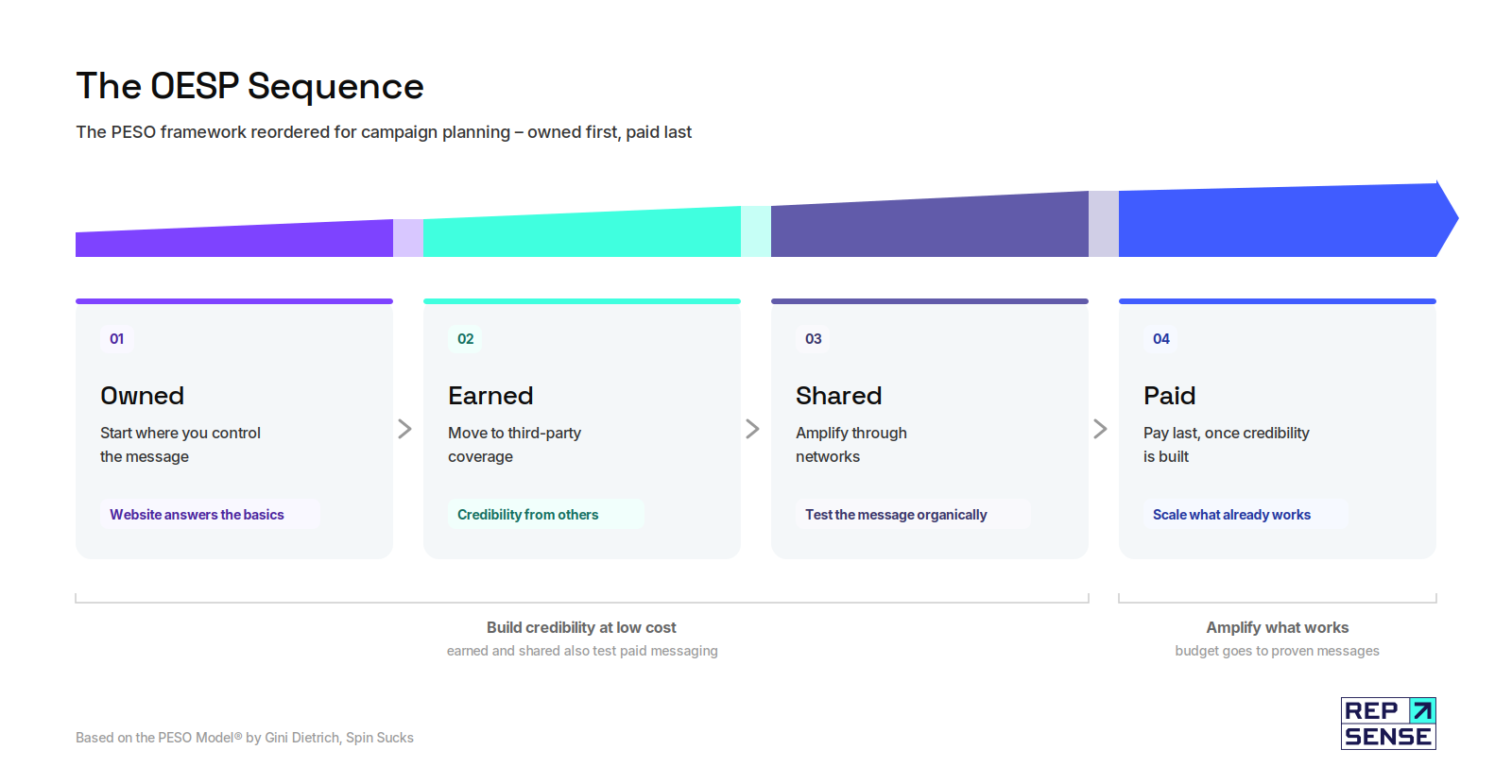
OESP model diagram – the PESO framework reordered as an owned, earned, shared and paid media sequence for campaign planning
What the PESO Model Does Not Measure
PESO categorises activity and output. It does not tell you what the audience retained: channel-centric by design, it measures where a message went, not what happened afterwards.For some jobs it is the right shape: PESO remains the more useful tool for planning and budgeting a campaign, structuring a communications team, and briefing agencies against clear channel ownership. Spin Sucks kept developing the model, repositioning it in 2025/26 as an integrated operating system rather than a static framework, but it still describes channel integration, not audience memory: what a person retains and later finds.
How Search Changes What Audiences Remember
Psychologist Daniel Wegner described transactive memory in 1987 in Theories of Group Behavior: a group's memory is what each member knows plus a metamemory of who knows what. You do not need to remember Beyoncé's entire discography if your friend Tony knows it by heart, only that Tony is the one to call about Renaissance. In 2011, Sparrow, Liu and Wegner's "Google Effects on Memory" study (Science 333, 776–778) found that people expecting future access to information recall where to find it, not the information itself – the internet as a primary form of external memory. Media noise produces not recall but a later search, and whatever that search returns becomes the brand's reputation.
What Does Transactive Memory Mean for Brand Recall?
A campaign that produces impressions but no later search has not entered memory in any usable way. Audiences do not store brand claims. They store a retrieval route through whatever answers their query. The noise is the last thing a brand fully controls; what the retrieval route returns decides reputation.
From Search Boxes to AI Answer Engines
The external memory store has since moved again: people increasingly ask an AI-driven assistant, so a single synthesised answer stands in for the whole results page. Traditional search still carries far more volume, but what an AI-generated answer says about a brand is not something a channel-based framework tracks: PESO shows what the assistant had to draw on, not what it actually says.
What Is the NIIS Model?
The NIIS model measures audience response across four stages: Noise, Impact, Interest and Signal. It was developed by the team at Repsense, a European narrative intelligence and media monitoring company, to track how public opinion about a brand forms.
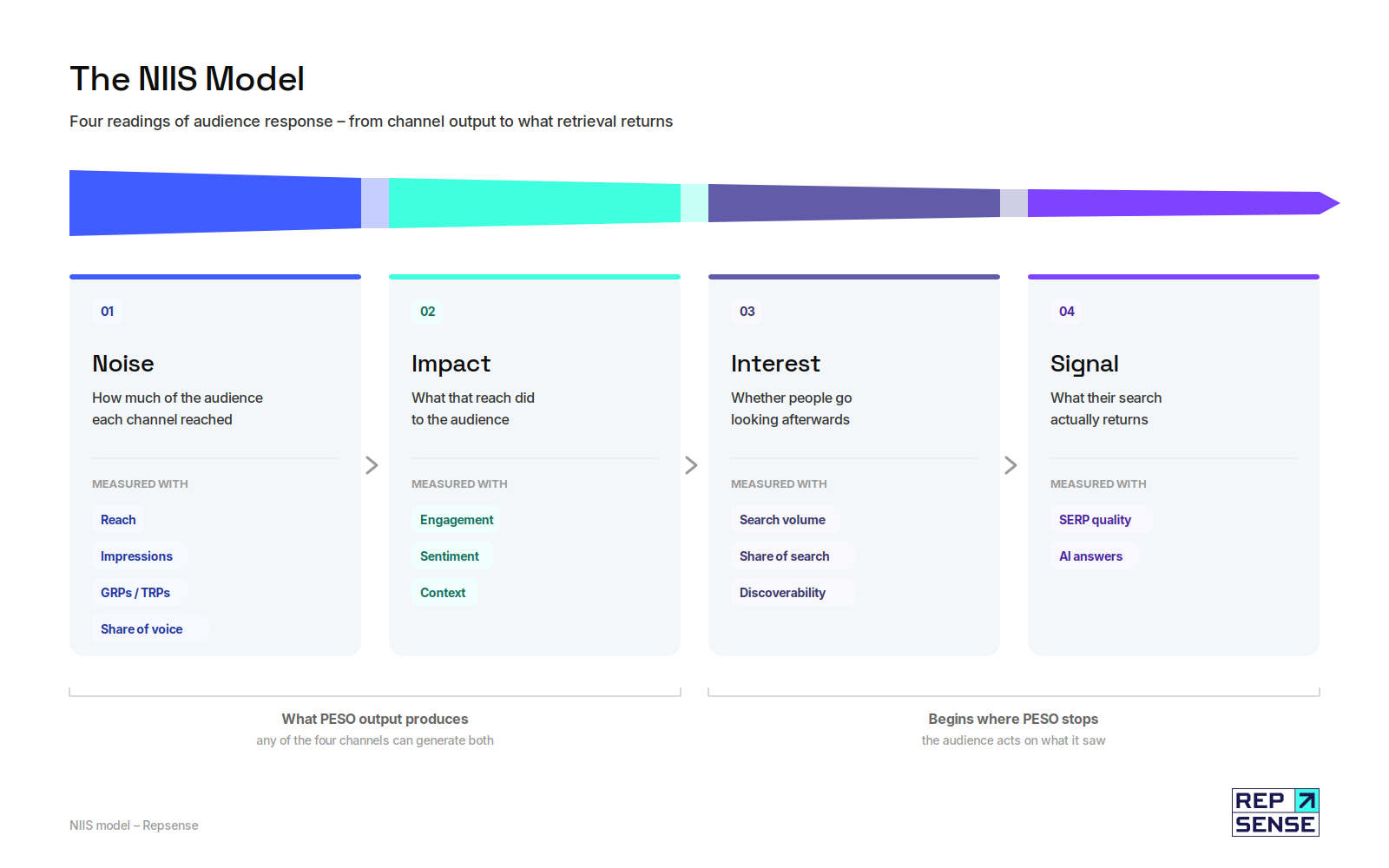
NIIS model diagram showing four measurements of audience response – noise, impact, interest and signal
The four components:
Noise measures how much of your audience each channel reached compared with competitors, using audience figures, GRPs or TRPs (one point equals 1% of the target audience), impressions, and share of voice – your percentage of the category conversation.
Impact measures the effectiveness of that reach, using engagement, media sentiment – the tone of coverage – and the context of each mention.
Interest measures search demand on your brand keywords, plus share of search and overall discoverability.
Signal measures what search engines and AI assistants actually return about your brand once interest becomes a query.
How the PESO and NIIS Models Compare?
| PESO Model® | NIIS Model | |
|---|---|---|
| What it measures | Communications activity by channel type | Audience response: reach, effect, what people then find |
| Unit of analysis | The channel: paid, earned, shared, owned | The audience stage: noise, impact, interest, signal |
| What it misses | What audiences retain and retrieve afterwards | Channel planning: budgets, briefs, team structure |
| Data required | Activity data: placements, posts, spend, coverage | Outcome data: reach, engagement, sentiment, search and AI answers |
| Best for | Planning campaigns, budgets and teams | What audiences seek and find after exposure |
| Relationship | The organising layer: decides what goes out | The measurement layer: two stages added after PESO stops |
PESO Model® is a registered trademark of Spin Sucks / Gini Dietrich. NIIS is the Repsense measurement model.

The two models are not mutually exclusive: PESO organises what a brand sends out; NIIS measures what comes back.
NIIS Extends PESO Rather Than Replacing It
Noise and Impact describe what PESO output produces: paid and earned media generate them just as shared and owned channels do; the source does not change the reading. Interest and Signal begin where PESO stops. A team running PESO does not discard it for NIIS; they add two measurement stages after it.
How to Measure the NIIS Model: Best Practices
Each component has defined metrics, data sources and a recognisable good result.
Noise
Were we seen?
Audience reach, impressions, GRPs or TRPs, and share of voice.
Media monitoring, ad platforms, analytics for owned traffic.
A rising slice of the category conversation: share, not raw volume.
Impact
Did it move people?
Engagement rate, sentiment across mentions, and prominence.
Platform engagement data, sentiment analysis over monitored coverage.
Reach paired with reaction: high Noise with flat Impact means the message reached people it did not move.
Interest
Did they look for us?
Search volume on brand keywords, share of search, branded query trends.
Search volume tools, Google Trends, search console data, website traffic.
Search demand that rises after campaigns and holds.
Signal
What did they find?
The first page of results for brand queries, its tone, and what AI assistants answer.
SERP monitoring plus repeated sampling of AI assistant answers.
A retrieval route you would choose: accurate, current, not dominated by a coordinated narrative.
Noise: Reach and Share of Voice
Metrics: audience reach, impressions, GRPs or TRPs, and share of voice. Data sources: media monitoring, ad platforms, analytics for owned traffic. A good result is share, not raw volume: a rising slice of the category conversation.
Impact: Engagement, Sentiment and Context
Metrics: engagement rate, sentiment across mentions on social media and in the press, and prominence (headline versus passing mention). Data sources: platform engagement data, sentiment analysis over monitored coverage. A good result pairs reach with reaction: high Noise with flat Impact means the message reached people it did not move.
Interest: Search Demand, SEO and Brand Discoverability
Metrics: search volume on brand keywords, share of search, and branded query trends. Data sources: search volume tools, Google Trends, search console data and website traffic. A good result is search demand that rises after campaigns and holds.
Signal: What Search Engines and AI Assistants Return
Metrics: the first page of results for your brand queries, its tone, and what AI assistants answer. Data sources: SERP monitoring plus repeated sampling of AI assistant answers; both change without notice. A good result is a retrieval route you would choose: accurate, current, not dominated by a coordinated narrative that has captured it.
NIIS in Practice: A Retail Chain
One recent quarter for a retail chain shows why the readings must be kept apart. On Noise the client led its market outright; a channel-based review would call the quarter a win. The Impact reading disagreed: the retailer was winning reach and losing tone, and the gap was structural.
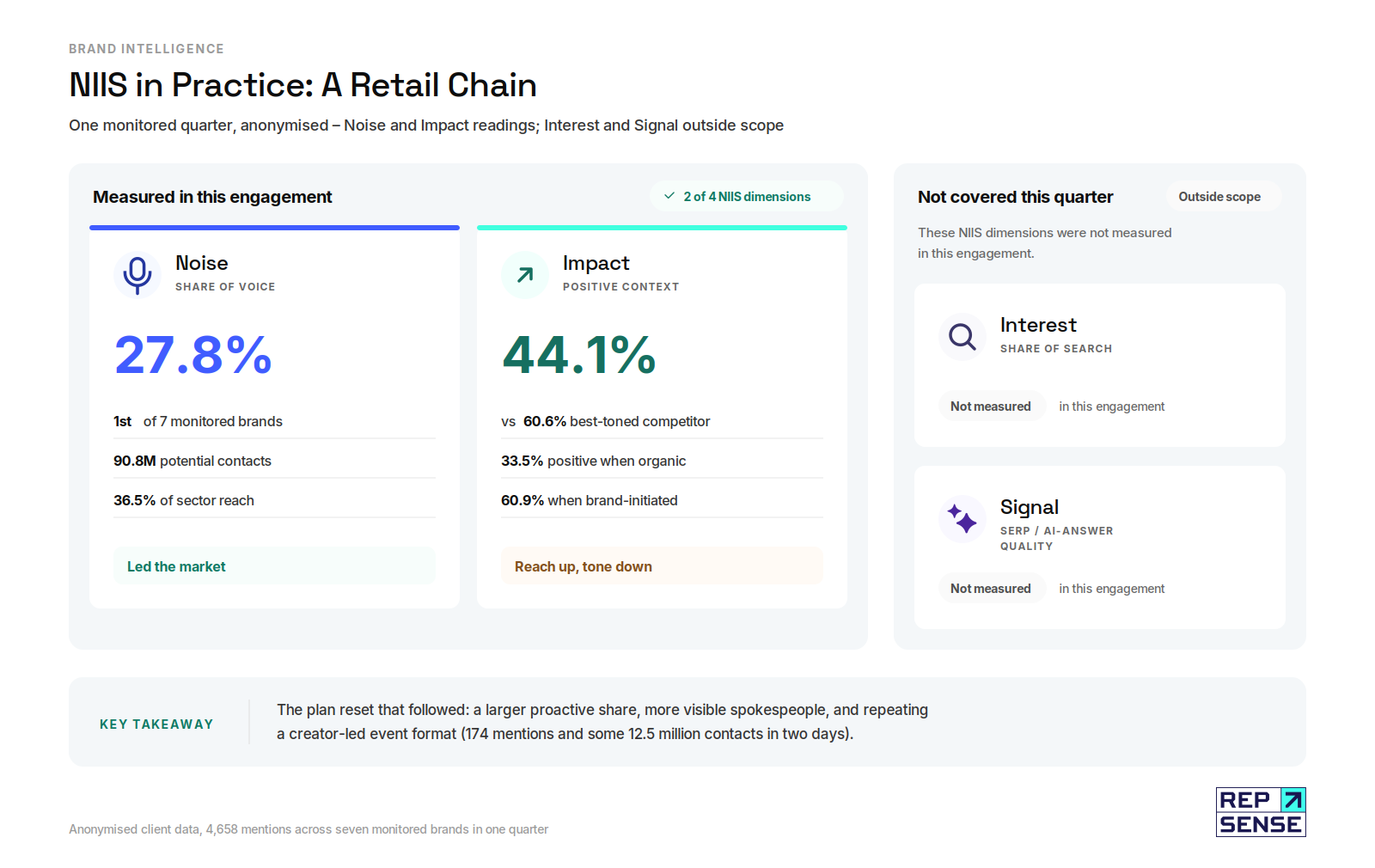
NIIS model readings for an anonymised retail chain – share of voice and positive-context scores; interest and signal not measured
That reset the plan: not more volume but a larger proactive share, more visible spokespeople – the dimension where a competitor led sixfold – and repeating a creator-led event format that produced 174 mentions and some 12.5 million contacts in two days.
PESO Organises the Message, NIIS Measures the Response
PESO decides what a brand sends; NIIS tracks what comes back: reach, effect, interest, and what people found. Two caveats: most audiences never reach the funnel's end, and not every brand journey runs online. See how the Repsense platform applies the NIIS approach, or book a demo and run the four readings on your brand.
FAQ
-
Yes, for channel planning. Spin Sucks repositioned PESO in 2025/26 as an integrated operating system, and it remains the strongest marketing model for organising the four media types – not for what audiences retain or later find. text goes here
-
Activity across all four PESO media channels feeds what AI systems work with: coverage, reviews, discussion and owned content. PESO organises that input, not what an assistant actually says about your brand.
-
Each PESO channel reports in its own units: GRPs for broadcast, impressions for paid social, mentions for earned, sessions for owned. Share of voice becomes meaningful once the four are normalised into one comparable measure – exactly what NIIS's Noise component does.
References
Columbia University. (2011). Study finds memory works differently in the age of Google. Columbia News. https://news.columbia.edu/news/study-finds-memory-works-differently-age-google
Dietrich, G. (n.d.). PR pros must embrace the PESO model. Spin Sucks. Retrieved September 8, 2026, from https://spinsucks.com/communication/pr-pros-must-embrace-the-peso-model/
Dietrich, G. (2014). Spin sucks: Communication and reputation management in the digital age. Que Publishing.
Sparrow, B., Liu, J., & Wegner, D. M. (2011). Google effects on memory: Cognitive consequences of having information at our fingertips. Science, 333(6043), 776–778. https://doi.org/10.1126/science.1207745
Spin Sucks. (n.d.). The PESO Model® — the MarComm operating system. Retrieved September 8, 2026, from https://spinsucks.com/peso-model/
Wegner, D. M. (1987). Transactive memory: A contemporary analysis of the group mind. In B. Mullen & G. R. Goethals (Eds.), Theories of group behavior (pp. 185–208). Springer-Verlag. https://doi.org/10.1007/978-1-4612-4634-3_9
Yaxley, H. (2020). Tracing the measurement origins of PESO. PR Conversations. https://www.prconversations.com/tracing-the-measurement-origins-of-peso/