

What Is Sentiment Analysis and How It Helps Decode Complex Narratives

In the era of social media and digital information overload, emotion has become the dominant currency - and attention its exchange (Illing, 2025). In this environment, what people feel often matters more than what is true. Understanding sentiment is therefore no longer optional - it is essential.
This article explores how sentiment analysis works, why it matters in today’s digital ecosystem, and how it helps uncover the emotional dynamics driving complex narratives across platforms.
What Does Sentiment Analysis Mean?
Sentiment analysis is the process, also known as opinion mining. It is a technique in natural language processing (NLP) that uses AI to analyze and interpret human language to determine the emotional tone behind a piece of text. By applying machine learning and deep learning models, it analyzes sentiment and classifies content as positive, negative, or neutral - often with far greater nuance at scale.
Put simply, it works like a scaled-up version of the smiley-face feedback buttons you see at airports - but instead of capturing a single reaction, it processes thousands or even millions of online conversations in real time.
This ability to decode emotional signals at scale is essential in today’s fast-moving digital environment. As narratives spread across platforms and audiences react instantly, sentiment analysis helps make sense of
What is being said
How is it being received
Why certain messages gain traction.
Why Is Sentiment Analysis Important?
The modern digital ecosystem is built on platforms designed to maximize engagement. Content that triggers strong emotional responses - anger, fear, excitement - keeps users engaged longer, and is therefore amplified by algorithms.
Research shows that emotionally charged content spreads faster and further than neutral information (Brady et al., 2021). Social media platforms reinforce this dynamic by rewarding immediacy, reaction, emotional intensity.
This has fundamentally reshaped communication. In political and public discourse, visibility often outweighs accuracy.
Without AI sentiment analysis, data remains:
Fragmented
Incomplete
Misleading at scale
A sentiment analysis model does not just read text - it evaluates how that text is designed to make an audience feel, uncovering the emotional triggers behind engagement.
Why It Matters for Decision-Makers
For organizations working in:
Public sector communication
Market research
Crisis monitoring
Strategic communications
this capability is critical.
AI-driven sentiment analysis enables:
Early identification of reputational risks
Real-time tracking of public opinion shifts
Data-driven decision-making
In practice, it helps pinpoint key moments of disruption or influence.
For example, in a NATO-related study (Jan 2024 – Mar 2025), sentiment analysis showed that Russian media sentiment peaked on November 6, 2024, following the election of Donald Trump - surpassing even major events such as Vladimir Putin’s re-election and Victory Day.
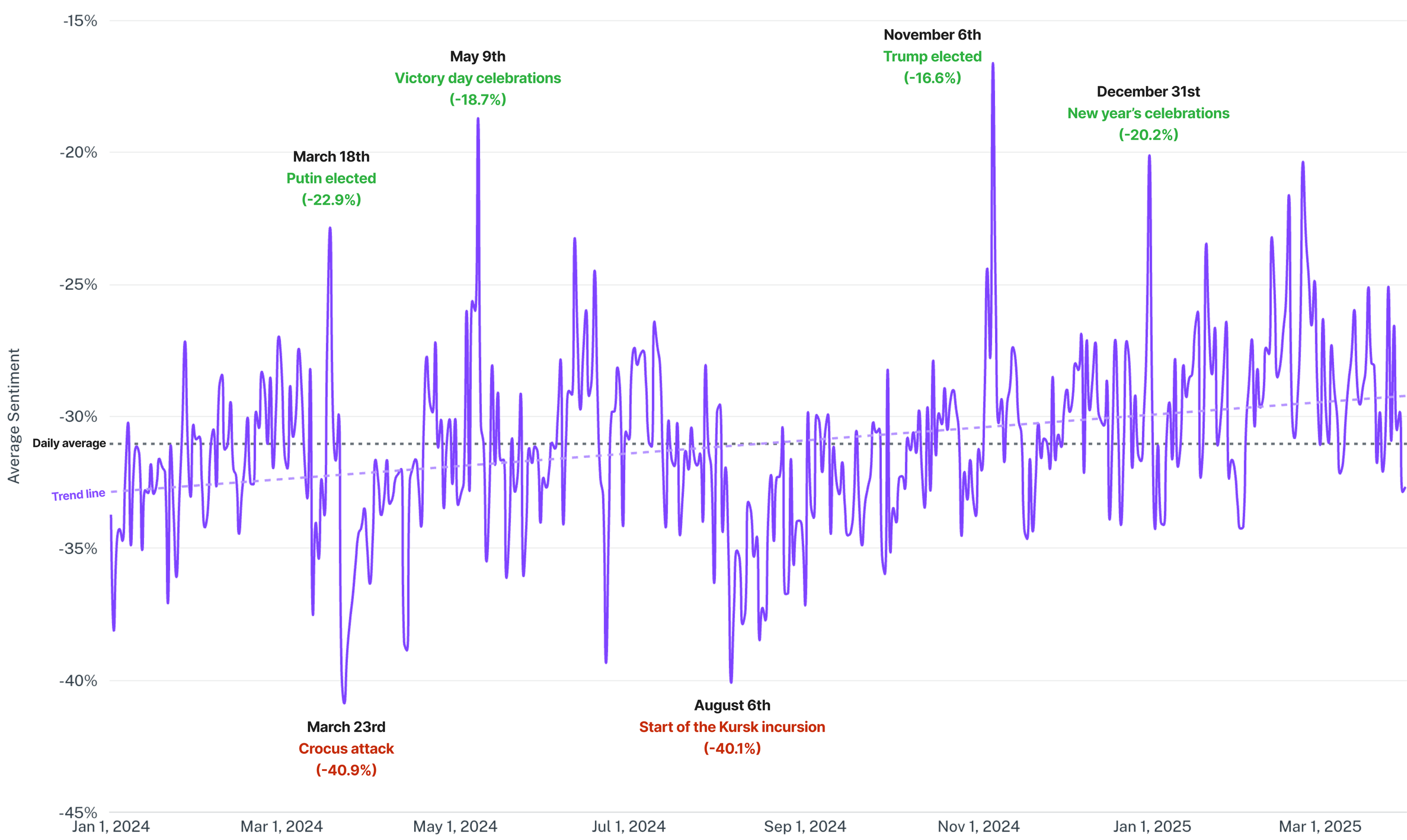
Russian media sentiment peaked after Donald Trump’s November 2024 election victory - surpassing even Vladimir Putin’s re-election and Victory Day.
How Sentiment Analysis Works
Sentiment analysis combines machine learning techniques with linguistic rules to process large volumes of text. These systems rely on sentiment analysis algorithms and sentiment classification to determine whether content is positive, negative, or neutral.
In practice, the approach used depends on the specific use case, data complexity, and required level of accuracy. There are different types of sentiment analysis and they fall into three main categories:
Rule-based
Machine learning-based
Hybrid approaches
The following section outlines how each of these works and where they are most effective.
Rule-Based Sentiment Analysis
Rule-based systems assign a sentiment score based on predefined dictionaries. It works by identifying keywords associated with positive or negative meaning and applying grammatical rules to determine the overall sentiment of a text.
While simple and transparent, these sentiment analysis tools struggle with context, sarcasm, and evolving language. Online communication is highly dynamic, shaped by memes, irony, and culturally specific references that do not exist in static dictionaries.
For example, a rule-based system would likely fail to interpret the meaning behind a viral trend like the “Nihilist Penguin 2026” TikTok. Without contextual understanding, it cannot detect whether the content is ironic, humorous, or emotionally charged in a way that resonates with audiences.

Viral Meme of Nihilist Penguin TikTok trend
As a result, rule-based sentiment analysis is often insufficient for analyzing today’s complex, fast-moving digital environments, where meaning is rarely conveyed through keywords alone.
Machine Learning Sentiment Analysis
Machine learning sentiment analysis uses trained AI models to detect patterns and interpret meaning at scale. These systems can capture nuance such as irony, humour, metaphors, and symbolism.
Unlike rule-based systems, they understand context; adapt to language changes; and deliver higher accuracy.
Advanced implementations often rely on models like DistilBERT, a streamlined version of BERT developed by Google.
Through knowledge distillation, DistilBERT retains most of BERT’s capabilities while being faster, lighter, and more scalable (Sanh, 2019).
The Hybrid Approach
A hybrid approach combines multiple analytical techniques to deliver more accurate insights.
It integrates:
Machine learning models (ml model) for pattern detection at scale
Rule-based methods for consistency and precision
Contextual analysis for tone, framing, and implicit meaning
This enables a deeper understanding of underlying narratives, emotional tone, and audience interpretation.
Aspect-Based Sentiment Analysis (ABSA)
Aspect-based sentiment analysis (ABSA) identifies sentiment toward specific elements within a text. For example:
“This restaurant serves the best coffee in town, but they should really improve their service.”
ABSA detects:
Positive sentiment → coffee
Negative sentiment → service
However, ABSA has its own limitations. It works best in structured environments. Whereas in real-world digital ecosystems, meaning often emerges through context and framing, irony and sarcasm, as well as visual and multimodal signals. In these cases, relying on ABSA alone is not sufficient.
How It Works in Practice
To address this, sentiment analysis is typically applied at the sentence level, with ABSA used as a complementary layer when deeper insight is required.
More advanced systems combine multiple techniques within a broader hybrid framework, integrating:
Sentiment analysis
Narrative analysis
Clustering and pattern detection
Multimodal data processing (text, image, video)
This allows for large-scale, real-time insights, particularly across social media posts.
Beyond Simple Positive/Negative Labels
Rather than relying on basic categories, sentiment can be measured on a continuous scale (e.g. from -100% to +100%), enabling more nuanced interpretation:
+15% → mildly positive
-80% → strongly negative
Crucially, sentiment is treated as context, not just a label. This makes it possible to distinguish between: negative topics vs negative perceptions of a specific actor
From Sentiment to Narrative Understanding
In today’s information environment, understanding sentiment alone is no longer enough. What matters is how narratives form, evolve, and spread across platforms.
Disinformation, public opinion shifts, and reputational risks are rarely driven by isolated statements. Instead, they emerge through:
Repeated framing across channels
Amplification within online communities
Cross-platform migration (e.g. from forums to mainstream social media)
Emotionally charged content that drives engagement
Capturing these dynamics requires moving beyond surface-level monitoring toward a more integrated approach - one that combines
Sentiment
Context
Narrative analysis
Solutions such as Repsense apply this type of hybrid methodology to map how stories
Develop over time
Identify key drivers of amplification
Detect shifts in tone before they fully materialise
Sentiment vs. Semantic Analysis - what’s the difference?
Sentiment analysis answers a simple question: how do people feel?
Semantic analysis, on the other hand, explains what they actually mean.
Not all sentiment analysis models require semantic understanding. For example, basic rule-based systems rely primarily on keywords and predefined rules to determine emotional tone.
However, in more advanced applications - such as fine-grained sentiment analysis or the detection of complex linguistic patterns - semantic analysis becomes essential.
This deeper layer enables systems to: interpret context and intent; understand nuanced meaning (e.g. double negation or ambiguity); and detect specific emotions, such as anger, frustration, or optimism.
In practice, combining sentiment and semantic analysis leads to more accurate and context-aware insights.
How is Sentiment Analysis Used?
Sentiment analysis is used to understand not just what people say, but how they feel - and how those emotions shape behaviour, decisions, and narratives at scale.
At a basic level, it supports a wide range of use cases, including:
Opinion mining
Customer experience analysis
Brand and reputation monitoring
At a more advanced level, sentiment analysis contributes to narrative intelligence, helping explain: how emotions are amplified, how they spread across platforms, and how they are translated into collective perception.
This shift moves analysis beyond isolated data points toward a broader understanding of influence and communication dynamics.
Sentiment Analysis For Voice of Customer
For companies, sentiment analysis acts as a real-time feedback loop, continuously tracking social media conversations, online reviews, and customer surveys. Organisations use sentiment analysis to measure customer sentiment, identify pain points, and detect emerging trends early.
Behind the scenes, the process begins with large volumes of public data, which are processed through multiple layers of AI-driven analysis:
Scored → to determine sentiment
Contextualized → to understand meaning
Analysed for patterns → to identify trends and anomalies
The resulting sentiment analysis results enable faster, more informed decision-making, allowing organisations to respond in real time and align their strategies with customer expectations.
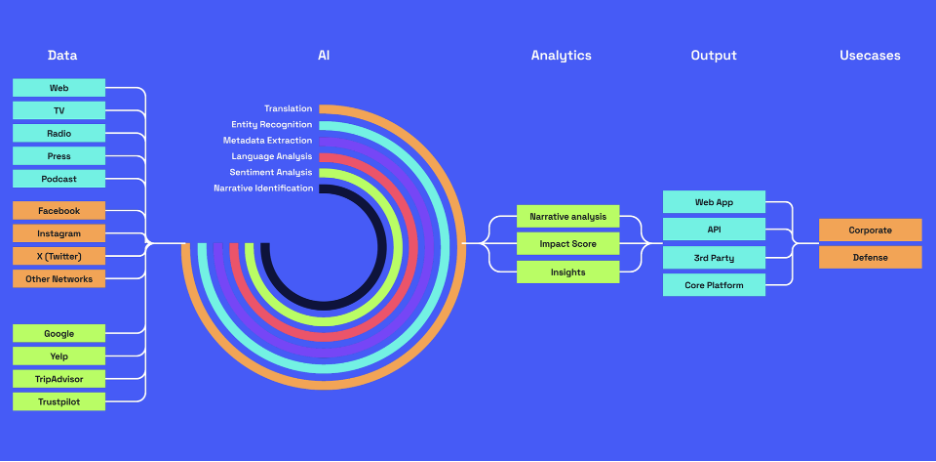
Repsense platform architecture: from multi-source ingestion to narrative intelligence
Sentiment Analysis in Strategic Communication
In public sector communication, political campaigns, and complex media environments, sentiment analysis reveals how audiences respond to messaging across social media platforms and traditional media.
It enables organisations to:
Identify shifts in public opinion
Detect emerging polarisation
Align communication strategies with audience sentiment
This provides a clearer, real-time view of how messages are received - and where they resonate or fail.
When combined with narrative intelligence, sentiment analysis goes a step further. It helps uncover:
How emotions are shaped
How they are amplified across platforms
How they are leveraged to influence public opinion and voter behaviour
In this context, sentiment is no longer just a metric - it becomes a tool for understanding the direction and dynamics of public debate.
Wrapping up
Sentiment analysis transforms unstructured, emotionally charged data into measurable insight - but in today’s information environment, that is only the starting point. As digital ecosystems become faster, more fragmented, and increasingly driven by instant reactions, understanding sentiment is essential for making sense of how information is consumed - and acted upon.
Yet sentiment alone does not tell the full story. To truly grasp modern communication dynamics, it must be placed within the broader context of narrative intelligence, where meaning is shaped across platforms, formats, and audiences.
This is where real value emerges: not just in identifying how people feel, but in understandinghow those emotions are formed, how they spread, and how they are transformed into influence.
In this sense, sentiment analysis is no longer just an analytical tool - it is a strategic capability for navigating today’s information landscape.
FAQ
-
Yes - models like ChatGPT can perform sentiment analysis by interpreting the tone and emotional intent of text.
However, they are not designed for large-scale, real-time analysis across complex information environments.
In particular, they cannot process massive, multi-source datasets simultaneously; track sentiment across platforms over time; and systematically evaluate sentiment toward specific entities (e.g. brands, political actors, or institutions).
As a result, while useful for individual text analysis, they are limited when it comes to monitoring entire information ecosystems at scale.
-
Yes - but only at a very limited scale.
Humans analyse content sequentially, one item at a time. For example, reviewing 1,000 Facebook comments can take anywhere from 4 to 8 hours - and even then, the results are often:
Subjective
Inconsistent
Difficult to compare
By contrast, advanced AI-driven platforms such as Repsense can process entire information environments simultaneously. They deliver:
Real-time sentiment insights
Analysis at scale
Consistent and comparable results
enabling organizations to move from manual interpretation to data-driven decision-making.
References
Brady, W. J., McLoughlin, K., Doan, T. N., & Crockett, M. J. (2021). How social learning amplifies moral outrage expression in online social networks. Science Advances, 7, eabe5641. https://doi.org/10.1126/sciadv.abe5641
Illing, S. (2025, February 1). The real stakes of the war for your attention. Vox. https://www.vox.com/the-gray-area/397131/the-gray-area-chris-hayes-attention-economy
Sanh, V., Debut, L., Chaumond, J., & Wolf, T. (2019). DistilBERT, a distilled version of BERT: Smaller, faster, cheaper and lighter. arXiv. https://arxiv.org/abs/1910.01108