
Evolving From Brand Protection to Narrative Protection
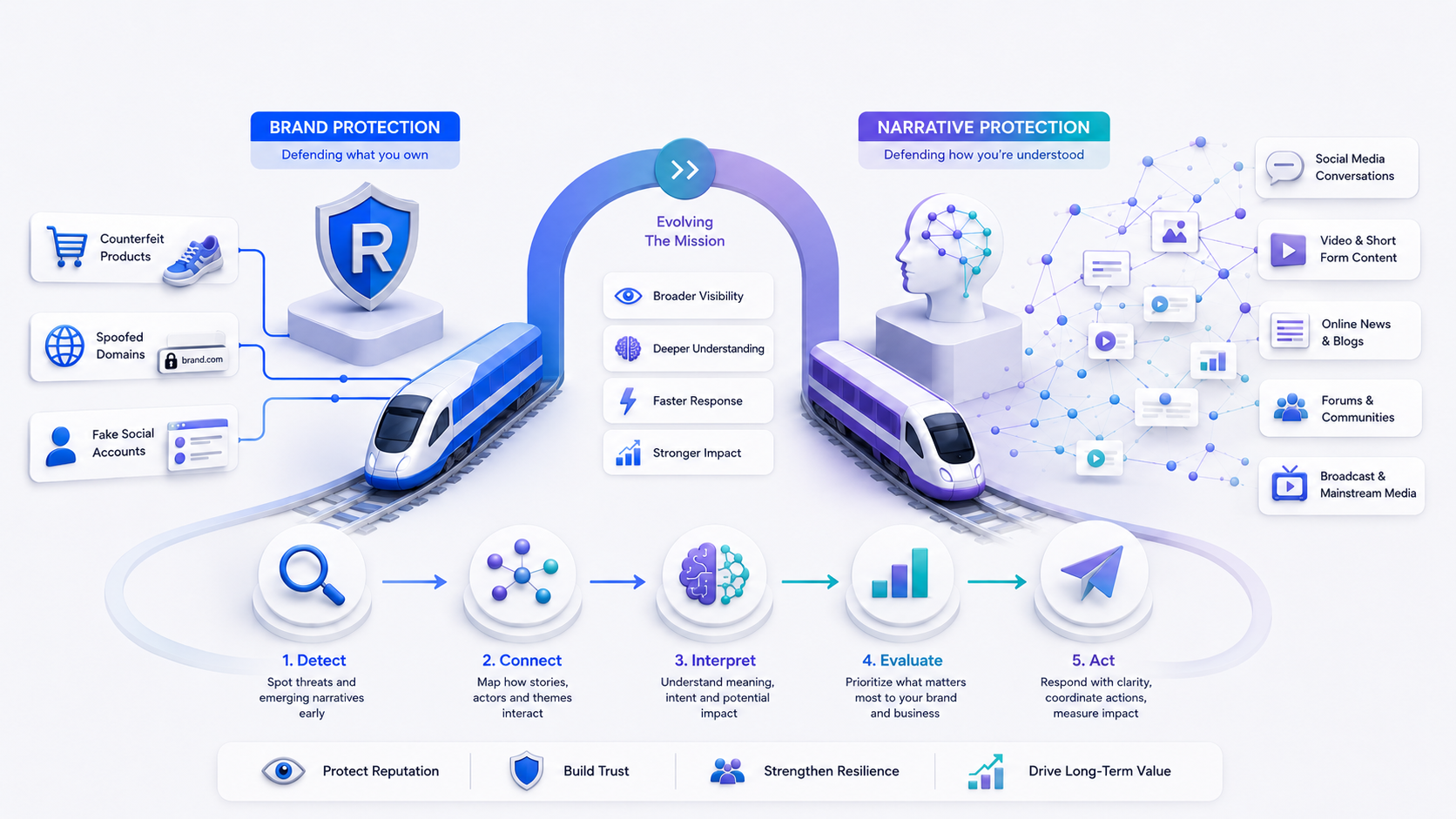
Brand Protection vs Narrative Protection | Repsense
Most brand protection strategies assume the threats that matter are things you can point to: a counterfeit product, a spoofed domain, a stolen logo. That logic works, and every brand owner needs it. But a second layer of risk carries no stolen asset and no infringement, yet drains brand value just as effectively. This guide maps both layers: what a company owns, and how it is understood.
What we mean by brand protection today
Brand protection is the set of legal, technical, and operational measures a company uses to stop unauthorised use of its brand assets: its brand name, trademark, logo, product images, and packaging. Narrative protection extends that defence to how the brand is framed and understood across the information environment.
Counterfeit, trademark, and infringement threats
Counterfeit goods imitate a legitimate brand's products
Trademark misuse trades on a registered mark
Infringement covers any unauthorised commercial use of protected intellectual property
The OECD and EUIPO estimate that trade in counterfeit and pirated goods reached USD 467 billion in 2021, around 2.3% of total global imports, with e-commerce a major enabler.
Brand owners must register marks in every relevant jurisdiction, monitor each major marketplace, and act on listings that infringe. This is the foundation of IP protection and of any effective brand protection strategy.
Brand impersonation and the digital brand
The same defensive logic now extends to surfaces the company does not own. Bad actors set up fake social media accounts, spoofed domains, and phishing sites that harvest payment details under a trusted brand's name.
The US Federal Trade Commission reported that consumers lost nearly USD 1 billion to business impersonators in 2025, with bank impersonators accounting for the highest reported losses. The digital brand (the profiles, listings, and pages that carry the brand identity across channels) has become an asset in its own right; digital brand protection applies the same takedown playbook to it.
The modern brand protection toolkit
Why are teams moving from point tools to integrated protection platforms?
Early online brand protection ran on separate point tools:
Marketplace listings: detecting counterfeit or unauthorised listings
Domains: identifying spoofed or infringing domains
Social media: finding fake or impersonating accounts
Each generated its own queue, and brand abuse that crossed channels fell between them. Teams now consolidate onto a single protection platform; one system of record shortens the path from detection to enforcement.
Online brand protection and IP protection
Online brand protection is the monitoring and enforcement layer: scanning online marketplaces, app stores, and social media platforms, filing takedowns, and tracking repeat offenders.
IP protection is the legal layer beneath it: trademark protection through registrations, disputes, and litigation.
A brand registry entry gives the takedown its legal teeth; the monitoring platform gives the legal team its evidence.
The risk traditional brand protection does not cover
Everything above defends assets; none of it defends perception, where much of a brand's reputational value forms.
Not every reputational threat is an infringement
Consider what the takedown playbook cannot touch: a viral video claiming your product harmed someone, or a review campaign framing your pricing as exploitation. Neither necessarily infringes your trademark or intellectual property, so there may be no fraudulent page to report and no legal basis to demand removal.
Why takedowns can win the case but lose the story
Even successful enforcement removes an artefact, not necessarily a belief. Lewandowsky and colleagues documented that corrections and retractions can fail to erase a claim's influence on what people remember and decide: the continued influence effect.
Translate that to a brand attack: a European appliance maker discovers counterfeit chargers on two marketplaces, alongside a spreading claim that its own chargers cause house fires. Enforcement works flawlessly. The listings come down in 72 hours, but the fire narrative keeps circulating through videos, posts, and reviews. The brand wins the case while losing the story; no takedown-volume metric captures the difference.
Narrative protection: defending how the brand is understood
Asset protection defends things you own. A second discipline handles meaning you do not control.
Narrative protection focuses on meaning, not ownership
Narrative protection monitors and contests the story forming about a brand across media, social platforms, and AI answer engines. It asks who is telling the story, whether amplification is organic or coordinated, and where it is heading. Asset protection asks a narrower question: is this ours, and is its use unauthorised? Narrative work requires continuous interpretation; asset work can end in a legal determination.
A small category of narrative intelligence platforms, Repsense among them, has emerged to serve this second question, analysing how narratives form, spread, and coordinate.
The practice remains young, roughly where cyber threat intelligence was fifteen years ago.
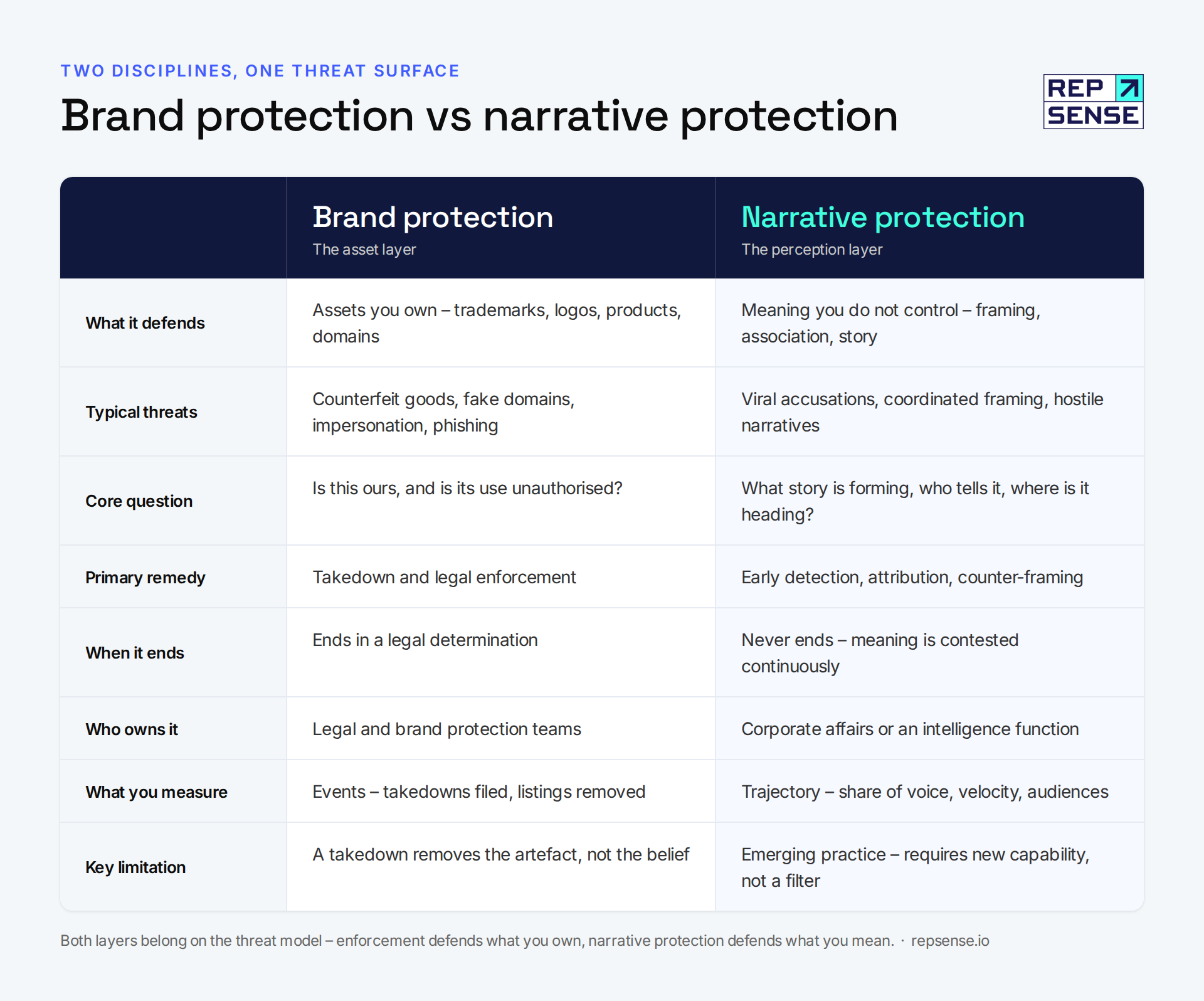
Brand Protection vs Narrative Protection – Comparison Table | Repsense
How repeated framing becomes brand reality
Fazio and colleagues found that repeated exposure to a claim increases its perceived truth even when people already know better, the illusory truth effect.
Repsense documented this mechanism for a wind-energy developer in the Czech Republic. Across 16 weeks, the analysis covered 5,139 Czech- and Slovak-language Facebook posts and comments, clustering 3,134 into 76 topic threads.
What initially looked like fragmented local opposition turned out to be a connected structure. Seven pages and groups formed the amplification core, with each pair co-appearing in an average of 24 shared threads. The highest-volume node, a Slovak-language group, fed content into the Czech pages as if it were domestic. False health claims carried the viral load; the top post, on infrasound, reached 2,765 users. The claims travelled inside a larger, mostly legitimate conversation about planning procedure, which made them effective. No trademark needed to be infringed for the framing to gain ground.
The trajectory finding mattered as much as the network map: the analysis identified a limited window for locally rooted engagement before the framing hardened. Counts tell you people are talking; trajectory analysis tells you who is reinforcing which interpretation and where it is heading.
Brand equity is partly an accumulation of framings. Whoever supplies the most persistent frame influences what the brand comes to mean, with or without owning its assets.
How narrative detection separates coordinated from organic amplification
Three behavioural signals do most of the work:
Co-appearance: the same accounts recur across unrelated threads more often than chance allows, as the seven Czech core entities did
Timing: coordinated seeding produces near-simultaneous posting, while organic conversation spreads unevenly
Cross-language seeding: content imported from an adjacent market and presented as domestic, as the Slovak-language group did for the Czech pages
These signals judge how content moves, not what people say.
Why AI answer engines raise the stakes
AI answer engines compress the dominant framings across the open web into a single response, with far fewer sources visible than a page of search results. A framing that wins the conversation increasingly becomes the answer.
A discipline is forming around this: generative engine optimisation (GEO), shaping how AI systems describe a brand as SEO shaped search rankings. Coverage must extend to what answer engines say about a brand, and counter-framing must reach the sources they draw on.
How to add a narrative layer to brand protection
Tools need to detect framing, not just infringement
Asset-layer detection is pattern matching: find the logo, match the listing, flag the domain. Narrative-layer detection is meaning reading: identify the claim, the frame it travels in, and who amplifies it. You cannot configure technology built for the first task into the second; adding a narrative layer means adding a new capability, not reconfiguring an old filter.
What to look for in a platform when reputation risk is the target
Evaluation criteria for a platform spanning both layers stay consistent:
Coverage: the channels where narratives form, including AI answer engines, not only where enforcement is possible
Signal quality: separating coordinated campaigns from organic criticism using behavioural evidence
Speed: identifying and contesting narratives before they become entrenched
Actionable output: clear next steps for specific teams rather than volume reports
Cost vs exposure: weighing cost against risk across both layers, not just one
The limits of narrative protection
The discipline carries its own risks. Organic outrage can resemble coordination: shared grievances produce shared timing, language, and sources, so behavioural signals generate false positives without careful thresholds. Labelling legitimate criticism "coordinated" damages trust faster than any external campaign; attribution needs behavioural evidence, not disagreement with the content. The ethical line is equally clear: narrative protection contests false claims with facts and transparency, never by suppressing criticism.
Decisions teams need to make before choosing a solution
Three decisions matter more than any vendor comparison.
Where do you sit on the maturity curve?
Most organisations move through four stages, from reactive takedowns to proactive narrative defence.
Stage one is reactive asset defence: takedowns on demand
Stage two is systematic asset defence: continuous monitoring, a protection platform, and measured enforcement
Stage three adds reactive narrative response: the team notices damaging framings after they spike
Stage four is proactive narrative protection: the team detects framings while small, separates organic from coordinated activity, and holds response plans before the spike
Most organisations sit at stage two and assume it is the finish line.
Who should own narrative protection?
Corporate affairs or a security-adjacent intelligence function should own narrative protection, with legal as a partner rather than the lead. Legal teams own asset defence because their remedies are legal, but no takedown resolves a framing problem. The owner needs to command communications, intelligence, and escalation paths.
What should you measure?
Measure trajectory, not event counts. Asset-layer metrics count events: takedowns filed, listings removed, mentions logged. Narrative-layer measurement reads which framings are gaining share of voice, how quickly, among which audiences, and whether your counter-framing bends the curve.
A claim that a product is unsafe holds 8% of relevant conversation in week one, 17% in week two, and 29% in week three. Total brand mentions may look healthy, but the trajectory shows a threat accelerating. If the frame then falls to 18% and 11% after an intervention while conversation stays high, the damaging frame has stopped gaining share.
The question changes from How much negative content did we remove? to Which interpretation is winning, and is its direction changing?
Brand protection now depends on controlling the story
The asset layer is not going anywhere, and brand protection still starts with registrations, monitoring, and enforcement. But protecting the assets is no longer enough: an attacker can damage perception without unlawfully using a single asset the company owns, leaving enforcement tools with little to act on.
Companies that adapt will treat the two layers as distinct but connected disciplines: enforcement for what they own, narrative protection for what they mean. The first removes infringements; the second detects which stories are taking hold early enough for communications teams to shape where they go next.
FAQ
-
Typically corporate affairs or a security-adjacent intelligence function, with legal as a partner; framing problems require communications and intelligence capabilities, not only legal remedies.
-
Corporate affairs or a security-adjacent intelligence function, with legal as a partner. Asset defence stays with legal and brand protection teams because their remedies are legal; framing problems need communications and intelligence capabilities instead.
-
By trajectory rather than event counts: which framings are gaining share of voice, how quickly, which audiences they reach, and whether counter-framing changes their direction.
References
Fazio, L. K., Brashier, N. M., Payne, B. K., & Marsh, E. J. (2015). Knowledge does not protect against illusory truth. Journal of Experimental Psychology: General, 144(5), 993–1002. https://doi.org/10.1037/xge0000098
Federal Trade Commission. (2026, June 15). FTC data show people reported losing $3.5 billion to imposter scams in 2025 [Press release]. https://www.ftc.gov/news-events/news/press-releases/2026/06/ftc-data-show-people-reported-losing-3-point-5-billion-imposter-scams-2025
Lewandowsky, S., Ecker, U. K. H., Seifert, C. M., Schwarz, N., & Cook, J. (2012). Misinformation and its correction: Continued influence and successful debiasing. Psychological Science in the Public Interest, 13(3), 106–131. https://doi.org/10.1177/1529100612451018
OECD & European Union Intellectual Property Office. (2025). Mapping global trade in fakes 2025: Global trends and enforcement challenges. OECD Publishing. https://doi.org/10.1787/94d3b29f-en