

Structured vs Unstructured Data: Key Differences Explained

Every organisation holds two kinds of information, and most teams only put one of them to work. The split between structured and unstructured data shapes which questions a business can answer, what data storage costs, and which skills the analytics team needs. This guide explains both data types, sets out their key differences, and shows how AI now turns the messy majority into something useful.
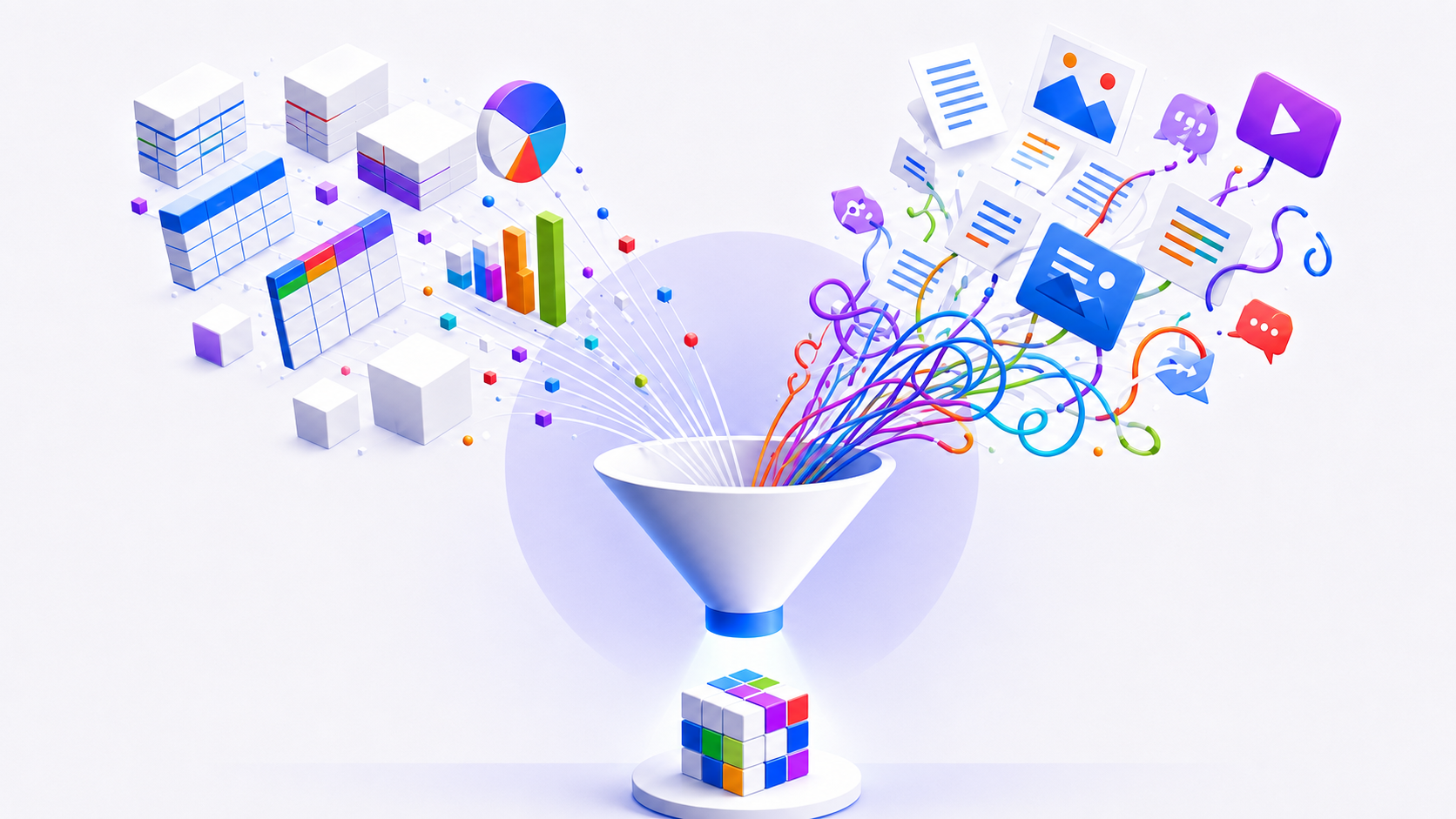
Structured vs Unstructured Data: Key Differences Explained | Repsense
What Is Structured Data?
Structured data is data that fits a predefined data model of rows, columns, and fixed fields. Every value has a defined place and meaning before anyone reads it. A sales table, for example, stores customer names, order dates, and amounts in set columns.
This type of data follows the relational model that Edgar Coddproposed in 1970, and it still runs most business systems today. Structured data is typically quantitative data: numbers, dates, categories, and short labelled text.
Common examples of structured data include:
Bank transactions and payment records
CRM fields such as names, emails, and deal values
Stock levels and product codes
Flight schedules and booking references
What Is Data Profiling and Schema Analysis?
Data profiling and schema analysis examine a dataset's structure before deeper analysis begins. Analysts review tables, fields, data types, relationships, missing values, and duplicates to understand how the data is organised and whether it is reliable enough to use.
Some teams describe this work more broadly as structural analysis of data. In practice, it combines schema profiling, data quality checks, and validation. Running these checks early helps teams identify gaps before they become expensive problems in a data science project.
In What Ways Is Structured Data Applied in Practice?
Teams use structured data wherever they need fast answers they can repeat. Analysts query it with structured query language (SQL), and results arrive in seconds.
Typical applications include:
Banking. Transaction tables power fraud checks and account reporting.
Retail. Inventory databases track stock across warehouses in real time.
Healthcare. Patient records store diagnoses, prescriptions, and appointment histories.
Marketing. Campaign dashboards compare spend against conversions by channel.
Strengths and Limitations of Structured Data
Structured data delivers speed and reliability, but it trades away flexibility.
Strengths:
Fast queries with mature, widely known tools
Easy validation, which supports high data quality
Compact data storage and predictable costs
Limitations:
A rigid schema resists change once live systems depend on it
It captures only what the data model anticipated
It misses context: tone, imagery, intent, and narrative
What Is Unstructured Data?
Unstructured data is information with no predefined data model and no fixed data format. Text, video, audio, and images all fall into this category. So do social media posts, emails, chat logs, PDFs, and many raw sensor data streams.
The scale is significant. Box-sponsored IDC research found that roughly 90% of organisational data is unstructured. A separate IDC forecast projected that unstructured data would reach 144.3 zettabytes by 2025, about 80% of the global datasphere. IDC's broader Data Age 2025 forecast put the total at about 175 zettabytes.
Unlike structured data, this material is mostly qualitative data. It records what people say, show, and share rather than what a form asked them to enter.
In What Ways Is Unstructured Data Applied?
Unstructured data answers questions that tables cannot. Organisations mine it for meaning rather than metrics.
Common uses:
Media monitoring. News articles and social posts reveal how narratives about a brand spread.
Customer intelligence. Support emails and call recordings expose recurring complaints.
Medical imaging. Scans and X-rays feed diagnostic models.
Industrial monitoring. Data from IoT devices flags equipment faults before they escalate.
Strengths and Limitations of Unstructured Data
Insights from unstructured data tend to be richer, and harder to extract.
Strengths:
It captures context, sentiment, and behaviour at scale
It arrives in massive volumes from big data sources
It often holds signals that competitors overlook
Limitations:
Unstructured data requires heavy processing before analysis
Storage options are cheap per gigabyte, but volumes balloon
Data quality issues, duplicates, and noise never disappear
Core Distinctions Between Structured and Unstructured Data
The key differences between structured and unstructured data come down to format, storage, analysis, flexibility, and processing cost.
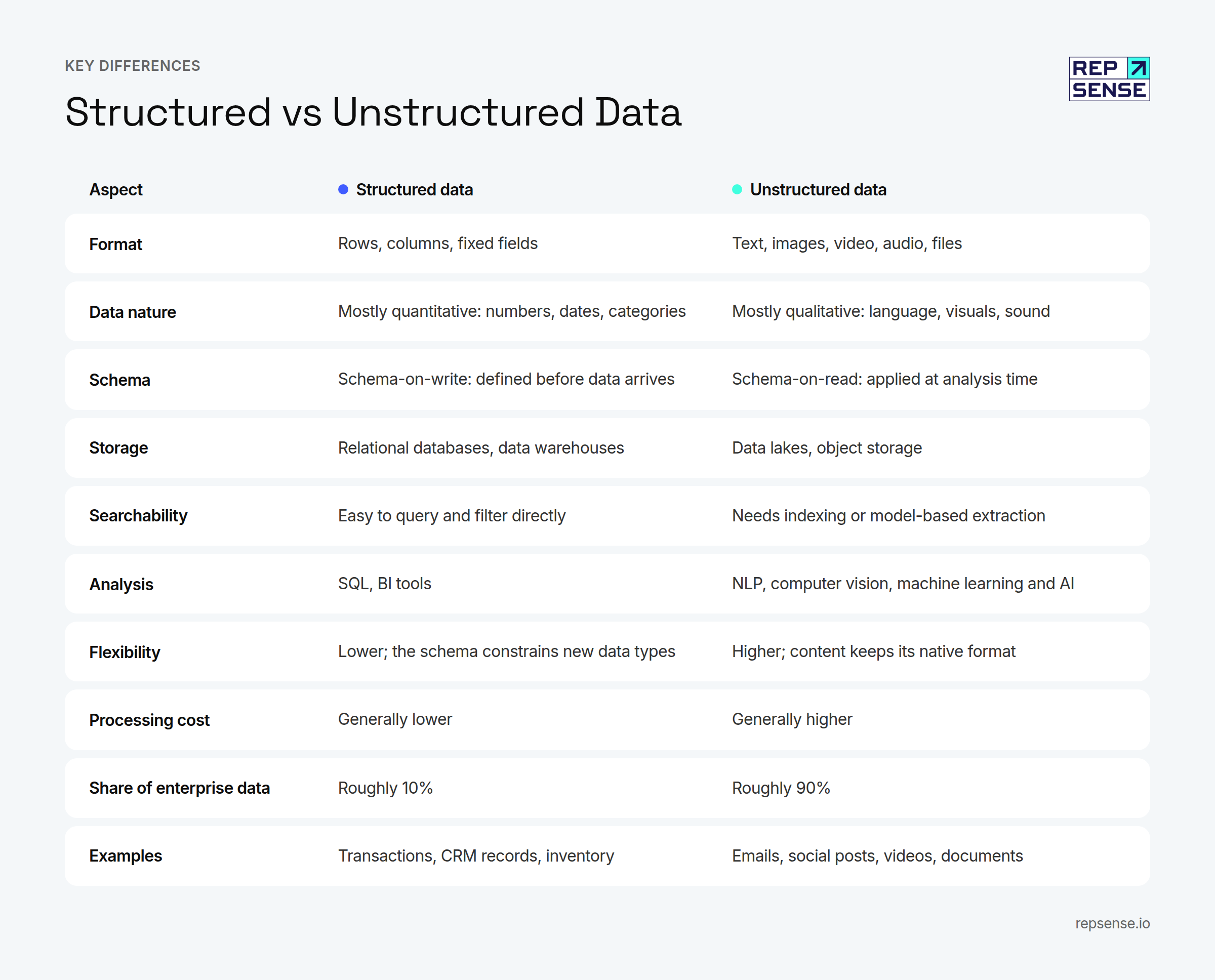
Structured vs Unstructured Data – Key Differences Comparison Table
How the Data Is Formatted
Structured data sits in rows and columns with fixed field types. Unstructured data keeps its native form: a video stays a video, and an email stays an email. Semi-structured formats such as JSON sit between the two.
How the Data Is Stored
Structured data typically lives in data warehouses and relational databases, where schemas enforce order. Unstructured data lands in data lakes or object storage, which can accept many file types at low cost. Many organisations run both data storage systems side by side.
How the Data Is Analysed
Analysts query structured records directly with SQL and visualise them in BI tools. Unstructured content needs an extra step: models first extract entities, topics, sentiment, or other signals. Analysts then work with that structured output. This is where machine learning and AI become especially useful.
Challenges of Working with Structured vs. Unstructured Data
Each type of data brings its own headaches. Structured systems struggle with change: adding one field to a live relational database can affect every application that reads it. Integration across scattered databases and data silos also consumes analyst time.
Unstructured data poses the opposite problem - too much freedom. Search is hard, governance is harder, and costs creep as volumes grow. Box-sponsored IDC research found that 60% of technology spend goes to structured data, while 40% goes to unstructured data. That investment pattern is inverted compared with where most organisational data actually sits.
What Is Structured and Unstructured Data in AI?
AI systems consume both data types, and increasingly convert one into the other. Large language models train on unstructured text, while many classic machine learning models expect structured features. Some of the most valuable AI applications sit at that junction: they read raw data and return structured, queryable output.
Narrative intelligence works this way. Repsense ingests large volumes of unstructured media, including news articles, social posts, videos, and comments. Its models convert that material into structured signals that analysts can compare, filter, and trace.
A simple before-and-after view shows the transformation:
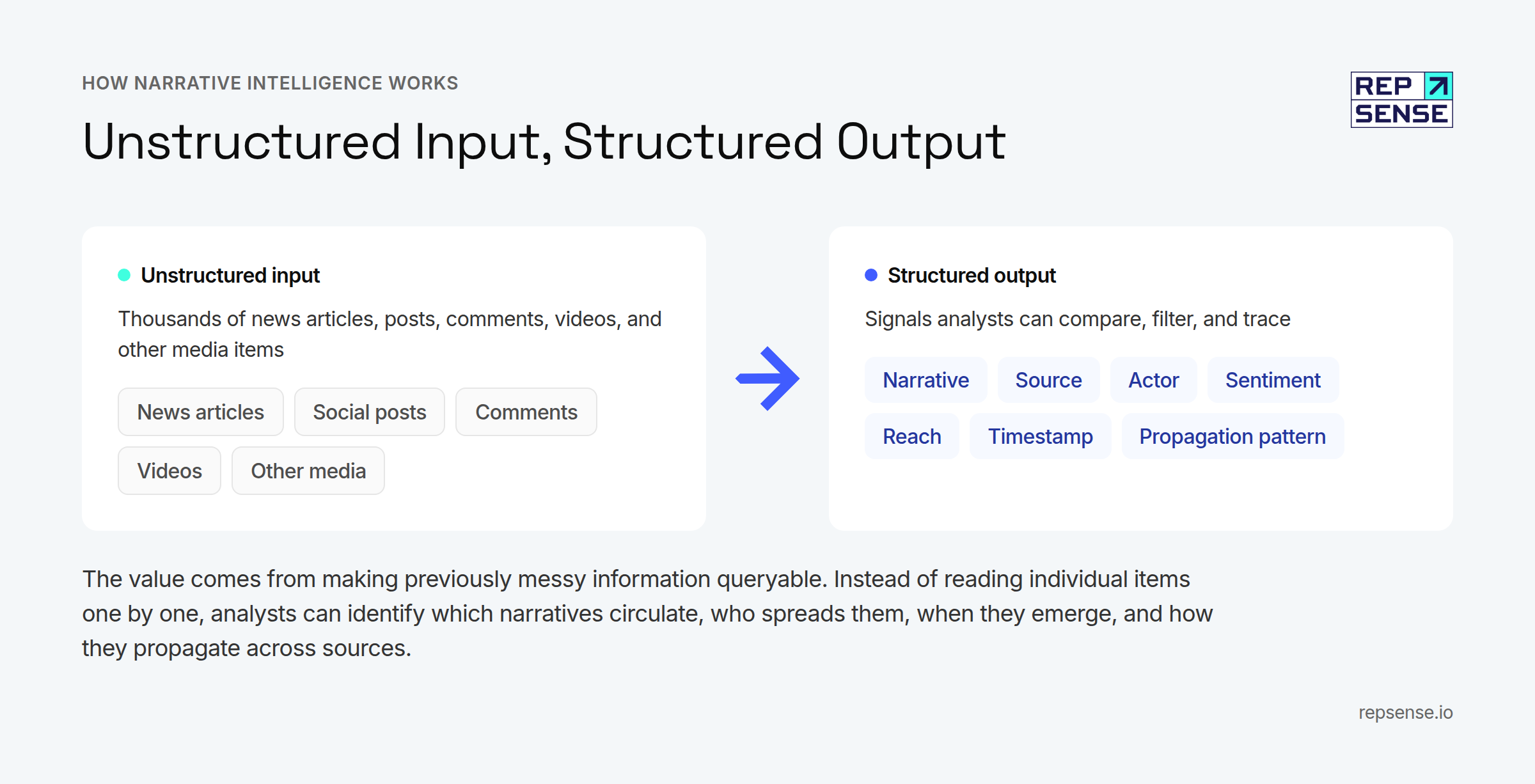
From Unstructured Data to Structured Data – Repsense Transformation Example
Deciding Between Structured and Unstructured Data
The decision follows the question, not the technology. Use structured data when you need exact metrics: revenue by region, churn by month, or stock by warehouse. Choose unstructured sources when you need to understand behaviour, perception, context, or emerging risk.
Budget matters too. Structured pipelines generally cost less to run, while unstructured analysis demands more compute and more specialised skills. Mature teams use both and route each question to the most efficient source that can answer it.
What Is Semi-Structured Data?
Semi-structured data carries organisational markers without a full relational schema. JSON files, XML documents, and email headers all tag their contents, yet each record can vary in shape.
Semi-structured data bridges the gap between the two main data types. It gives machines enough structure to parse the content, while giving producers enough freedom to change it. Many modern APIs and event streams use semi-structured formats by default.
How Do Structured and Unstructured Data Work Together?
Structured data and unstructured data meet constantly in modern pipelines. A monitoring platform extracts entities from news text, then matches them to a structured watchlist. A retailer can link product reviews to the sales records of those same products.
The pattern repeats: models turn unstructured input into structured fields, and databases handle the resulting information. This combination powers customer 360 projects, risk monitoring, and many modern data analytics programmes.
Bringing It All Together
The difference between structured and unstructured data defines how organisations store, query, and use information. Structured records deliver precision and efficient analysis. Unstructured content carries richer context but requires more processing before teams can analyse it systematically.
The strongest data strategies connect the two. They use AI and data pipelines to turn unstructured information into structured signals, then combine those signals with established databases. That allows organisations to answer questions that neither data type can address as effectively on its own.
FAQ
-
Machine learning treats the two data types differently. Structured data feeds classic models such as regression and decision trees, which expect numeric features in fixed columns. Unstructured data trains deep learning systems: language models learn from raw text, and vision models learn from images. Many production pipelines first convert unstructured inputs into structured features, then combine both for prediction and scoring.
-
Structured data comes from transactional systems: payment platforms, CRM software, ERP tools, and booking engines. It flows into relational databases and data warehouses for reporting. Unstructured data comes from people and machines: emails, social media, video, call recordings, and sensor data from IoT devices. It lands in data lakes or object storage, where analytics teams process it on demand.
-
SQL remains the core tool for querying structured datasets. BI platforms such as Power BI, Tableau, and Looker sit on top of data warehouses for dashboards and reports. For profiling and schema checks, teams use dbt, Great Expectations, or built-in database utilities. Python libraries, notably pandas, handle exploratory work when analysts need more flexibility than a dashboard offers.
References
Amazon Web Services. (n.d.). What is a data lake? AWS. https://aws.amazon.com/what-is/data-lake/
Supports: data lake definition in “How the Data Is Stored”. Anchor: “lakes”
Codd, E. F. (1970). A relational model of data for large shared data banks. Communications of the ACM, 13(6), 377–387. https://doi.org/10.1145/362384.362685
Supports: origin of the relational model, “What Is Structured Data?” section. Anchor: “Codd”
Malick, R. (2023, August). 90% of your data is unstructured – and it’s full of untapped value. Box Blog. Based on the Box-sponsored IDC white paper Untapped value: What every executive needs to know about unstructured data (Doc. US51128223). https://blog.box.com/90-your-data-unstructured-and-its-full-untapped-value
Supports: roughly 90% of organisational data is unstructured; 60% of technology spend goes to structured data and 40% to unstructured data. Anchor: “IDC research”
Rivkin, J. (2022). The value of member experience data platforms for payers and the role of unstructured data (IDC Spotlight, Doc. CA48885222BRO; sponsored by OpenText). IDC. https://www.opentext.com/assets/documents/en-US/pdf/idc-opentext-spotlight-value-of-member-experience-en.pdf
Supports: IDC forecast that unstructured data would grow to 144.3 ZB by 2025, about 80% of the global datasphere. Anchor: “IDC forecast”
Seagate Technology. (2018, November 26). Seagate launches new data-readiness index revealing impact across four global industries as 30 percent of data forecasted to be real-time by 2025 [Press release]. Summarises the IDC white paper The digitization of the world – from edge to core (Data Age 2025), sponsored by Seagate. https://investors.seagate.com/news/news-details/2018/Seagate-Launches-New-Data-Readiness-Index-Revealing-Impact-Across-Four-Global-Industries-As-30-Percent-Of-Data-Forecasted-To-Be-Real-Time-By-2025/default.aspx
Supports: forecast that the total global datasphere could reach about 175 ZB by 2025. Anchor: “Data Age 2025 forecast”