
The Quiet Campaign Behind Armenia's Election

Research conducted in partnership with the International Practitioners’ Partnership Network (PRACTNET) and Sihtasutus Liberaalne Kodanik (SALK).
AT A GLANCE
What did Repsense find in Armenia's 2026 election?
A coordinated Russian influence operation built to suppress pro-Western turnout rather than persuade undecided voters – and defeated at the ballot box despite its scale. It ran six interlocking hostile narratives that questioned democratic governance, portrayed Western engagement as self-serving, framed peace as surrender, and presented Russia as Armenia’s most reliable security partner.How did these narratives spread?
They moved through a four-layer architecture: Russian state-linked Telegram channels, Armenian-language Telegram relays, a coordinated cluster of 13 TikTok accounts, and reactive government accounts trailing far behind.Did these narratives reflect public opinion?
No. The gap was striking. Across all twelve narrative scales, the information environment was between 28 and 71 percentage points more hostile than public opinion. Armenians were exposed to the Russian argument at overwhelming volume. They heard it. They simply did not buy it.What happened to the disinformation infrastructure after the election?
It remained active. The accounts, networks and narratives identified during the campaign continued operating after the vote, suggesting the effort extended beyond election day.Why does Armenia matter beyond its borders?
Researchers found narrative patterns previously observed in Moldova, Germany and Lithuania, suggesting that influence operations increasingly rely on reusable narratives and distribution networks that can be adapted across countries.
Read the full report here: https://repsense.io/armenia-report
Few elections in Europe's neighbourhood carried as much geopolitical weight as Armenia's parliamentary vote in June 2026.
The country entered the campaign amid a historic attempt to normalise relations with Azerbaijan, growing ties with the United States and renewed efforts by the European Union to draw Armenia closer politically and economically.
This was happening just as Yerevan was distancing itself from the Russian-led CSTO security alliance and openly questioning a security relationship that had shaped Armenian foreign policy since the collapse of the Soviet Union.
When Armenians went to the polls on 7 June, they were voting on their geopolitical future. Prime Minister Nikol Pashinyan's Civil Contract party won despite months of Russian pressure, disinformation campaigns and economic coercion.
The campaign, however, was fought on more than one front.
The operation, the monitoring would later show, was not built to persuade undecided voters. It was built to suppress pro-Western turnout by demoralising the government’s own supporters.
The Same Playbook, Different Country
Researchers identified familiar patterns: narratives previously deployed in Moldova, Germany and Lithuania had been repackaged for Armenian audiences, with local actors and grievances substituted into an already established framework.
The implication is unsettling: influence operations increasingly appear to be reusable. Rather than building a new campaign from scratch for every election, operators can increasingly rely on pre-existing infrastructure, established audiences and proven narratives.
Methodology
Repsense monitored Armenia's information environment from November 2025 to June 2026, collecting 1.8 million media items and 6.42 million sentences across 12 platform categories, including TikTok, Telegram, Facebook, YouTube, online media and broadcast content. The analysis tracked twelve pairs of opposing election-related narratives using a combination of AI-assisted detection and analyst review, with the operational structure reconstructed from 11,896 propagation clusters.
At the platform level, the study traced how narratives moved from Russian-state Telegram channels through Armenian-language relays into TikTok amplification. Network analysis was used to identify coordinated behaviour and distinguish organic discussion from infrastructure-driven amplification.
This made it possible to examine not only how narratives spread across platforms, but also whether online discourse reflected broader public opinion, measured against a nationally representative survey.
Narrative architecture
The campaign was not built around a single message. It relied on six interlocking narratives that reinforced one another and pointed in the same strategic direction:
Democracy is a facade.
Armenia needs a strong leader, not a weak democracy.
The West uses Armenia for its own purposes.
NGOs are foreign agents and instruments of outside influence.
Peace with Azerbaijan is surrender.
Russia is Armenia's only reliable security guarantor.
Viewed separately, the narratives addressed different issues. Viewed together, they suggested that democratic institutions were weak, Western engagement was dangerous, and Armenia's future ultimately depended on Russia.
This was not a coincidence. The narratives were locked together by design. If democracy is a facade, elections are rigged. If the West uses Armenia, NGOs are foreign agents. If Russia is the only guarantor, diversification becomes national suicide. Contesting any one narrative left the rest of the system intact. The stack had to be challenged as a system.
The Four-Layer Pipeline
The narratives followed a clear route through the information ecosystem.
Russian state-linked Telegram channels moved first, setting the themes that would later appear elsewhere. Armenian-language Telegram channels then adapted those themes for domestic audiences. A tightly connected group of 13 TikTok accounts then repackaged them for younger users and pushed them into the mainstream. Government accounts formed the fourth and final layer – reactive one.
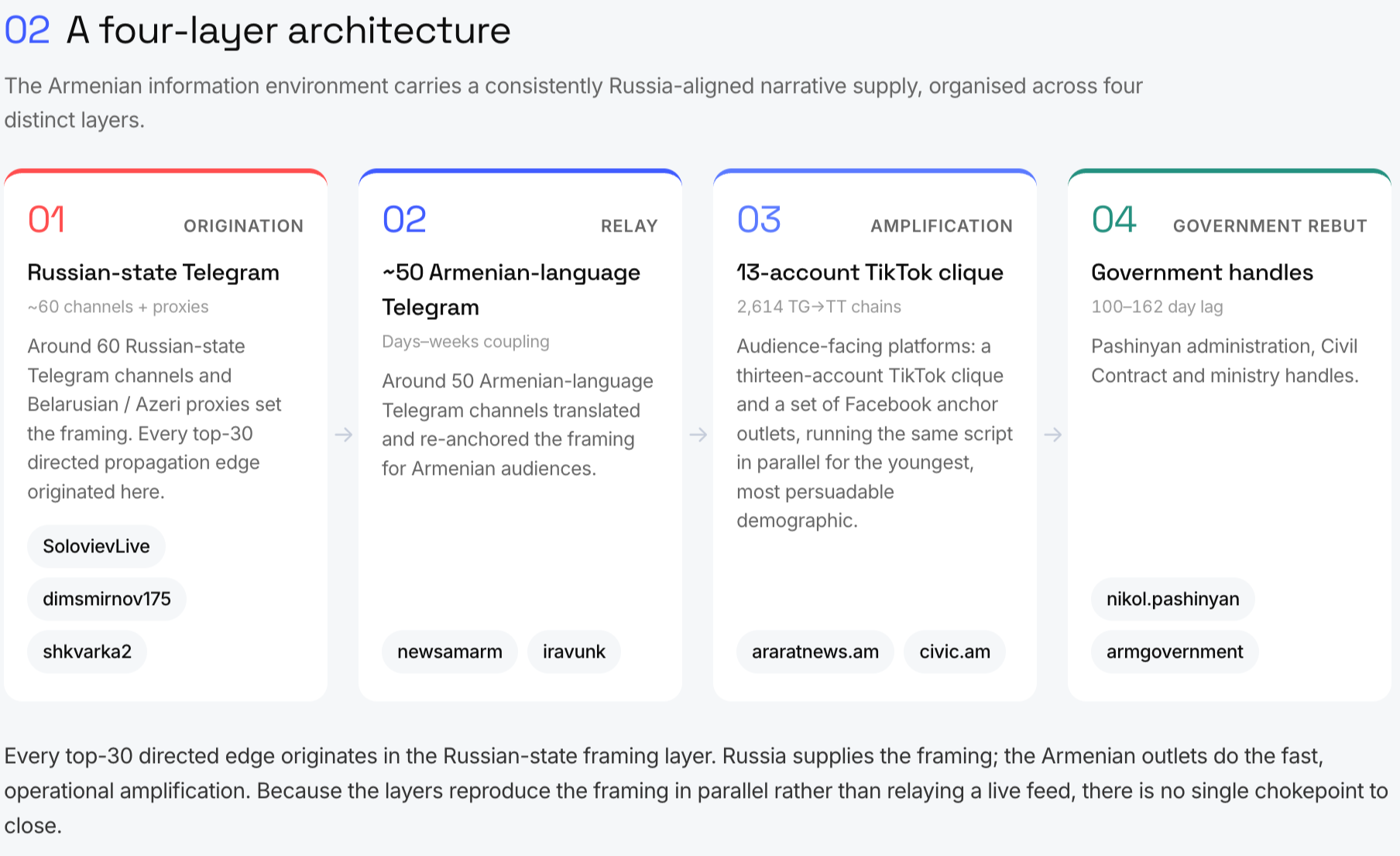
As the campaign progressed, the process became faster. Narratives that once took weeks to move between platforms began appearing within hours.
Manufacturing consensus
A 13-account coordinated clique anchored every major anti-government narrative on Armenian TikTok, cross-posting as a functionally single operation.
On the platform as a whole, 95% of accounts carried the same stance stack – a user scrolling TikTok saw what looked like near-universal agreement. Government voices carried just 2% of narrative volume at the start of the campaign, rising to 4% after the EU Civilian Mission and only 8% after the election win.
The picture emerging from TikTok often differed sharply from broader public opinion. Across all 12 issues examined, platform narratives were consistently more extreme than public attitudes – by 28 to 71 percentage points on TikTok above what the public actually believed.
The starkest divergence fell on the question that defined the election – Russia versus diversification. The Armenian public leaned decisively towards diversifying the country’s foreign policy beyond Russia, yet the media environment pushed the opposite way.
The “strong leader” narrative reached 73.7 million contacts against 19.5 million for “the country’s future is democratic” – a 4:1 reach advantage. Opinion did not follow the volume.
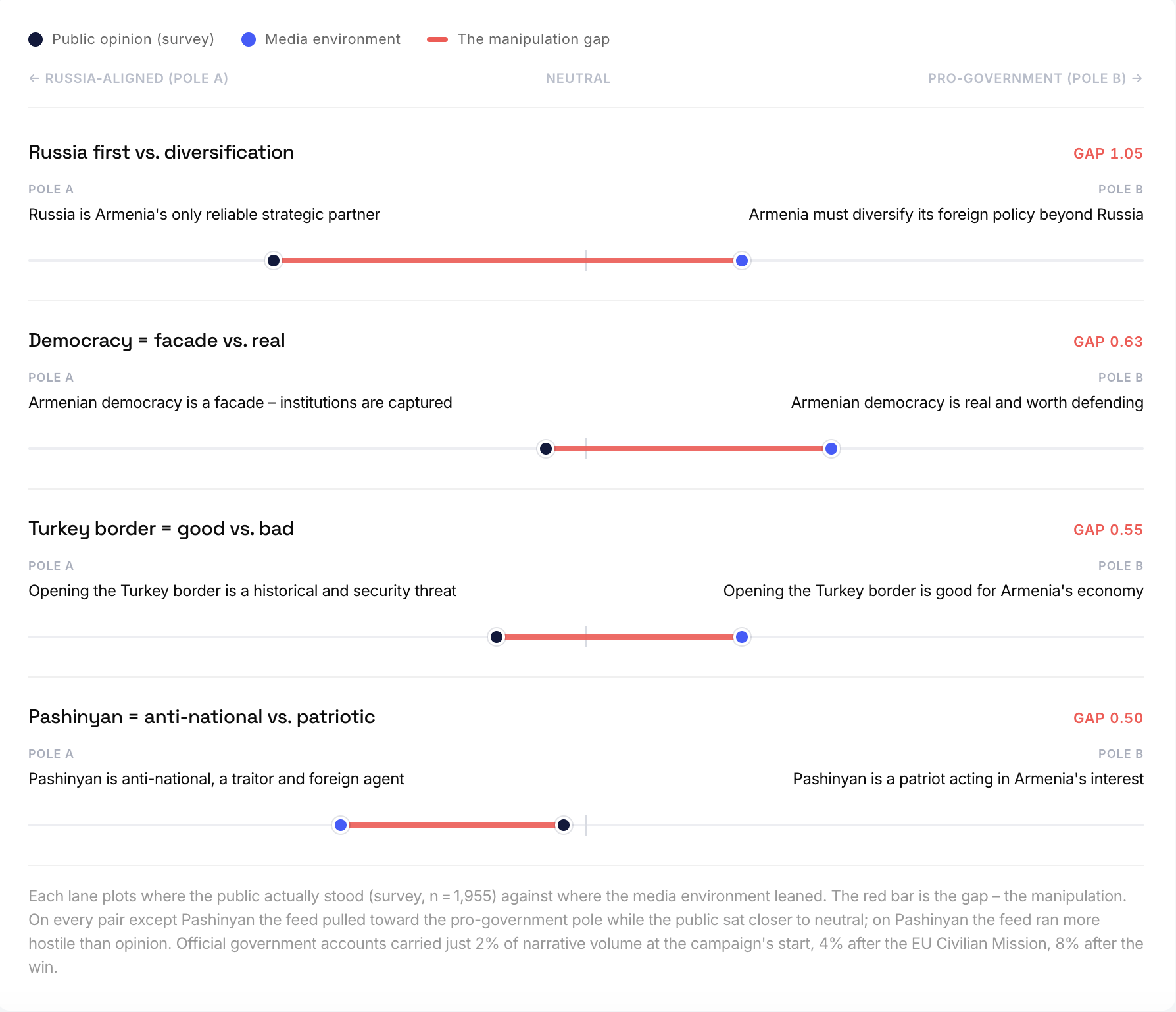
The result was an information environment that looked considerably more hostile to the government's agenda than the polling suggested.
The Debunking Trap
One anti-government slogan surged three times during the campaign. The first two spikes came from opposition figures. The third came from Armenia's Speaker of Parliament, who repeated the slogan in order to denounce it.
For TikTok's algorithm, the distinction was largely irrelevant. The slogan was repeated, engagement followed and the topic gained visibility.
This created a paradox: in trying to rebut hostile narratives, government communicators often helped amplify them. Throughout the election, efforts to challenge hostile narratives frequently increased their visibility instead.
Two Campaigns, One Election
Russia appeared to be running two campaigns at once.
In the final weeks, Moscow escalated to open, attributable pressure: trade frictions after late-April customs changes, the suspension of Armenian sellers on Wildberries and Ozon, a block on Jermuk water exports, gas-price warnings, and the recall of its ambassador on 30 May. It was loud, visible and counterproductive. By attacking the European choice so openly, Russia turned the election into a referendum on Europe – and elevated the very choice it opposed. The pro-European vote held at 49.8% on the highest turnout since 2017.
Beneath the coercion ran a second, quieter campaign – the narrative infrastructure built steadily across the full eight months. The "democracy is a facade" narrative outpaced its counter 3:1 and widened every week; the thirteen-account TikTok clique operated uncontested throughout; the Armenian-language Telegram layer reproduced the Russian-state script daily.
The Takeaway
Eight months of monitoring documented a coordinated Russian influence operation: a six-narrative stack, a multi-layer distribution pipeline from Russian-state Telegram to Armenian TikTok, and a playbook already observed elsewhere in Europe.
The operation was built to suppress rather than persuade. It focused on identity and alignment, amplifying hostile positions by 28 to 71 percentage points above public opinion. Yet Armenians largely rejected the message.
At the ballot box, the operation failed. The pro-European vote held at 49.8% on the highest turnout since 2017. But the underlying narrative infrastructure remained intact, helped carry a combined 33% pro-Russian bloc into parliament, and continued operating after election day.
Throughout the engagement, the monitoring detected the operation's components – the playbook template, the diaspora network, the fabricated-video frames, the coordinated account clusters – months before external investigations confirmed them. Continuous narrative intelligence delivered a lead time that reactive analysis cannot. That lead time, and the analytical framework that accompanied it, is the core value the engagement demonstrated.
None of this monitoring happens in isolation. The engagement was carried out in partnership with the International Practitioners’ Partnership Network (PRACTNET) and with Sihtasutus Liberaalne Kodanik (SALK), whose sociological research anchored the findings in representative public opinion. Partnerships of this kind are what allow narrative monitoring to be tested against reality rather than read on its own.
Repsense Havel Narrative Intelligence platform maps the narratives shaping public conversation – where they originate, how they travel between traditional and social media, and which actors are pushing them. The platform separates organic discussion from coordinated and inauthentic activity, then quantifies each narrative's reach and impact so teams can see what is gaining ground before it becomes a problem.
