

Study: Hungarians Debunked Orbán's Propaganda Faster Than It Could Spread
Orbán’s Propaganda Cracked Before It Could Take Hold in Hungary
Going into Hungary's parliamentary election, one side of the information contest had an extraordinary head start. Fidesz controlled an estimated 80% of the country's media landscape and had spent years building coordinated digital infrastructure on top of it. The opposition had neither.
On April 12, Péter Magyar's Tisza Party still won 138 of 199 parliamentary seats - a two-thirds supermajority - on record turnout of nearly 80%. The result was shaped by many things, Magyar's political rise chief among them.
Repsense, a narrative intelligence company, spent the three months before the vote looking at a specific, narrower question: what was actually happening to state-backed narratives on social media, moment by moment, as they collided with an unorganised public?
Across roughly 180,000 public Facebook posts and more than 15,000 TikTok videos, one pattern showed up repeatedly: the response to each state-backed operation travelled further and faster than the operation itself.
Civil society outran the propaganda machine
The Orbán government did not lack the tools of information control. Fidesz controlled an estimated 80% of Hungary's media landscape - a dominance built over a decade and a half, spanning public broadcasters, national dailies, regional press, and online outlets. On top of that, the party had spent years constructing coordinated digital infrastructure: a network of official and proxy Facebook groups designed to amplify specific content, and, on TikTok, dominance by the Fidesz parliamentary faction account and aligned outlets such as Origo and Ripost.
The machine was working as designed. Pro-government messaging reached Hungarians in large volumes across every platform the campaign touched. What the data showed, however, was that reaching people and convincing them had become two different things. Narrative after narrative, the counter-response was faster, sharper, and further-reaching than the message it was responding to.
"The information environment had developed an immune response - each new provocation only accelerated its own exposure," said Katkus.
Every provocation backfired
The clearest case came on March 15, Hungary's national holiday. At the Tisza Party's National March in Budapest, eight or nine young men pushed into the crowd in a tight formation, unfurled a four-metre Ukrainian flag on cue, and photographers appeared from balconies above. It was the image the pro-government press would need to run the line about foreign-backed opposition.
Within 24 hours, the independent outlet 444.hu had identified the participants as members of a Fidesz-linked digital campaign agency, photographed earlier that day with the chairman of Fidelitas Budapest, the party's youth wing.
The original provocation scored 28on Repsense's viral intensity index, which measures how fast and how far a narrative spreads. The exposure thread scored 44 - more than 50% higher - and reached half its total audience in under an hour.
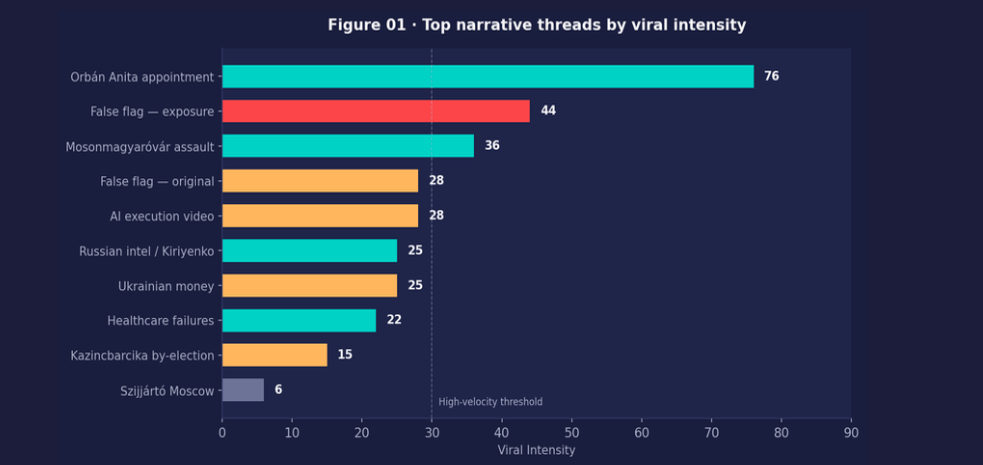
Top Narrative Threads by Viral Intensity
The same dynamic repeated across the dataset. The falsified framing of Ukraine’s Oschadbank cash-in-transit seizure, an AI-generated video depicting a young Hungarian girl searching for her father while he is being executed in war, the implausibly favourable polling from the government-aligned Nézőpont institute - in every documented case, the counter-narrative achieved higher viral intensity than the operation it exposed.
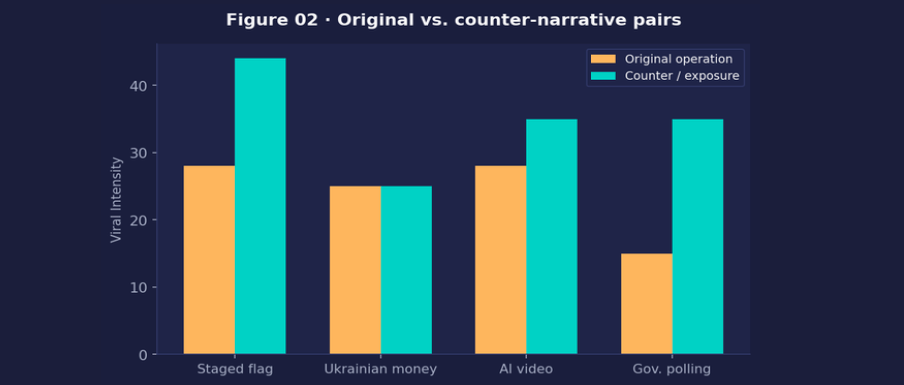
Original vs. counter-narrative pairs
"The information environment had developed an immune response - each new provocation only accelerated its own exposure," said Katkus.
Kremlin narratives ran mainly through Fidesz’s own channels
Analysis confirmed that the Kremlin's narrative playbook was clearly present in Hungarian social media: pro-Orbán sovereignty framing, anti-Brussels and anti-Ukraine war messaging, with Magyar Péter consistently portrayed as a "Brussels puppet".
But rather than operating through a separate covert network - the place most observers look for Russian interference - the data showed these narratives were amplified mainly through Orbán's own campaign infrastructure. Official party accounts and pro-government media outlets led the largest coordinated clusters of Kremlin-aligned content.
TikTok posting volume escalated sharply as election day approached - a 16-fold increase from December to March - with notable spikes coinciding with the Orbán-Putin phone call on March 3 and the Szijjártó leaked audio scandal on April 8.
Yet even as the volume surged, the discourse did not shift. Each new operation triggered a faster and more effective public response.
"What we documented in Hungary is not just a story about one election," said Katkus. "It is a textbook case of how social media functions not just as a manipulation tool but as a mechanism for civil society to withstand state propaganda. A population that received enough exposure to manipulation developed a collective ability to detect and reject it in real time. That is a finding with implications far beyond Budapest."
For further details about the study or a demonstration of the Havel platform’s capabilities, please contact us at: info@repsense.com