

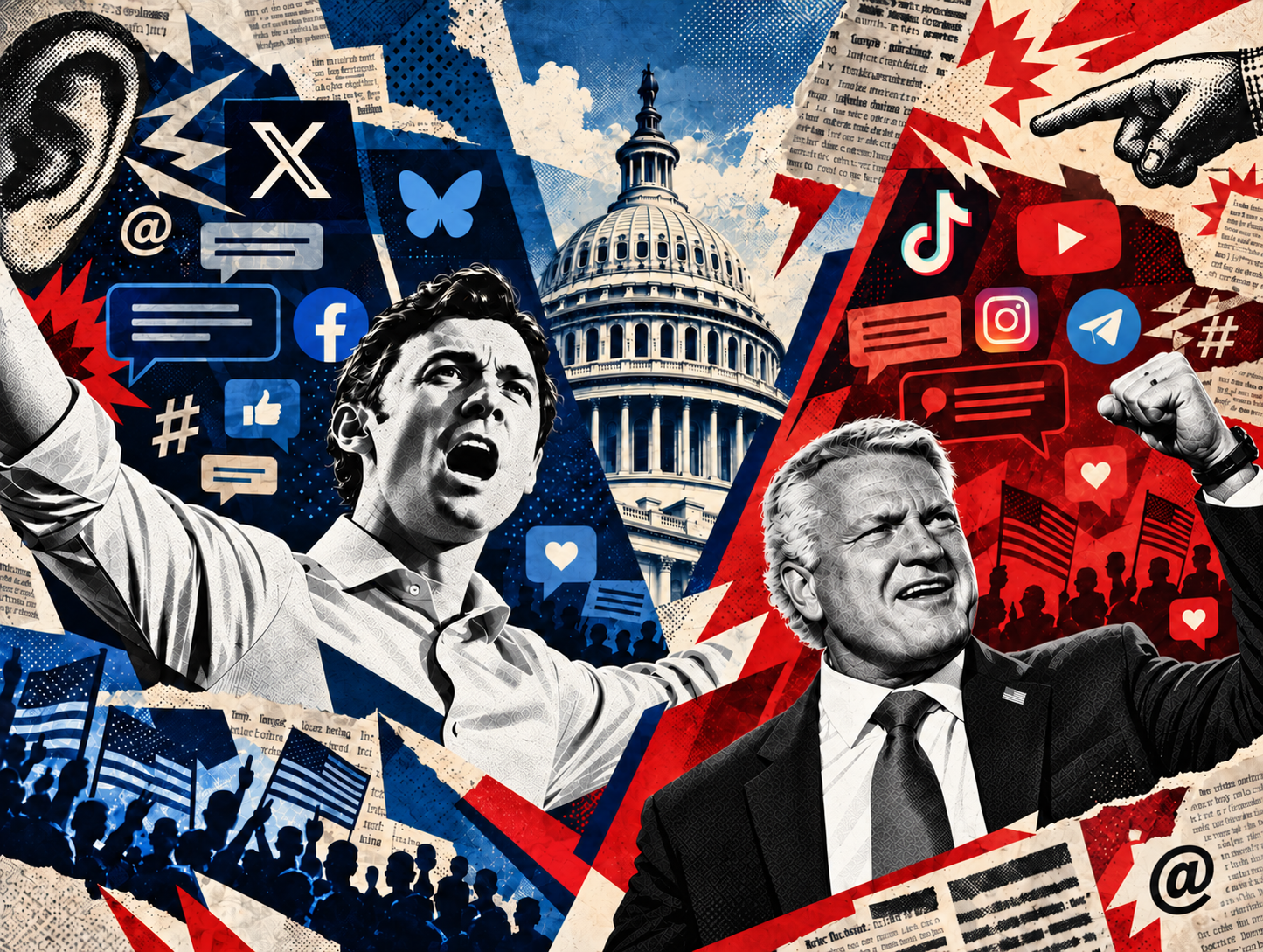
In Georgia's Senate election, Democratic-framed posts outnumbered Republican-framed ones by nearly eight to one. Of the posts discussing Republican candidate Mike Collins' character and political record, 85% advanced Democratic-framed arguments.
The imbalance raises a question that extends far beyond Georgia: who gets to define a political candidate when the conversation surrounding them is shaped as much by opponents, controversies and digital platforms as by their own campaign?
Ahead of the November 3 midterm elections, Repsense analysed 12,447 posts from 6,040 accounts, collected between August 21 and October 13, 2026, across X, Bluesky, Facebook, Instagram, TikTok, Truth Social, Rumble and podcasts.
The research into Georgia's Senate election reveals how competing political narratives emerge, gather momentum and influence the terms of public debate. It also exposes a fundamental distinction in modern political communication: producing a message, attracting attention and determining how that message is understood are not necessarily the same thing.
The distance between voter concerns and political attention
The cost of living remains one of the defining concerns for Georgia voters. In three Georgia polls, by Fox News, AARP and Emerson College, affordability accounted for 38–61% of voters' answers on their most important issue.
Yet the political conversation surrounding Georgia's Senate election has devoted considerably more attention to candidates than to the policies they propose.
In the monitored data, candidate-related discussion outnumbered policy-related discussion by approximately three to one (9,163 posts to 2,866). Political records, personal conduct and controversies attracted far more attention than detailed proposals on healthcare, taxation or immigration.
That difference matters because the issues voters consider important and the arguments dominating political conversation are not necessarily the same. Affordability accounted for only 23–28% of online policy posts.
Corruption provides a particularly revealing example. Democratic Senator Jon Ossoff’s anti-corruption message was one of the largest narratives in the monitored conversation, appearing in 546 posts from 362 accounts. (The report’s issue-area chart shows 949 Democratic-framed posts on elections, democracy and corruption because that figure covers the whole category, of which Ossoff’s anti-corruption message is the largest single part. Corruption also featured in attacks on Collins: 183 posts discussed the House ethics investigation into him.) Elections, democracy and corruption together accounted for 38–46% of online policy posts, compared with 12–20% of voters’ top-issue answers in the same Georgia polls.
Recent national polling suggests that corruption is also becoming increasingly salient beyond Georgia. A Fox News poll, conducted October 9–12, found that 60% of registered voters were extremely concerned about government corruption, compared with 58% extremely concerned about inflation and high prices. An August Change Research survey found that 40% of registered voters ranked government corruption among their three most important issues, up from 34% in February.
“Jon Ossoff is a magnetic candidate, and his anti-corruption message is now resonating far beyond Georgia: national polls show corruption climbing towards the top of voters’ concerns,” said Mykolas Katkus, CEO of Repsense.
The national findings do not establish how Georgia voters rank the issue specifically. They do, however, complicate the assumption that economic concerns and political integrity occupy separate places in voters' priorities.
Political campaigns respond to public concerns, but they also compete to determine which concerns receive sustained attention and how they are understood.
A corruption allegation can become an argument about institutional integrity. A dispute over immigration can become a judgment about a candidate's character. A policy disagreement can be transformed into a question of trust.
The political contest is therefore not only about competing answers to public problems. It is also a struggle for narrative dominance: the ability to determine which issues, controversies and interpretations come to define the public conversation.
Who gets to define a candidate?
One of the clearest findings of the Repsense analysis was the scale of the imbalance between Democratic- and Republican-framed political arguments.
Across the monitored conversation, Democratic-framed posts outnumbered Republican-framed posts by nearly eight to one (8,287 to 1,043).
The disparity was especially pronounced in discussion of Mike Collins' political image. Of 2,266 monitored posts concerning his character and political record, 85% were Democratic-framed and 7% Republican-framed, meaning that much of the conversation advanced criticisms of the Republican candidate rather than the image promoted by his supporters.
Posts calling Collins a bigot appeared 345 times, from 264 accounts, while another 219 discussed reports that a former Collins staffer and his son-in-law had shared extremist content. Two of Ossoff's lines from the October 8 debate also became recurring attacks: that Collins would be "grabbing a billy club" if civil rights leader John Lewis marched from Selma today (97 posts), and that he had hired "half the Third Reich" to staff his office (88 posts).
The significance lies in the cumulative effect of these arguments. They created a political portrait in which Collins was repeatedly discussed through controversies raised by his opponents. None of the largest attacks on Collins drew a Republican counter-narrative that met the report's listing criteria.
“Georgia is the most interesting Senate race of this cycle, and what surprised us is how lopsided the online fight is. Republicans aren’t being outshouted, they are simply not showing up,” said Katkus.
Collins’ visibility, meanwhile, was closely tied to President Donald Trump. During debate week, Trump's endorsement and the announcement of his October 16 rally in Dalton, held after the monitored period, became the largest Republican-framed narrative, accounting for approximately one in six Republican-framed posts. By comparison, Governor Brian Kemp's endorsement drew 6 Republican-framed posts. Democrats framed him through Trump even more often: 160 posts portrayed him as Trump's loyal vote.
This raises an important question about political identity. What happens when a candidate's opponents generate most of the arguments defining him, while his supporters rely heavily on the reputation and visibility of another political figure?
The findings do not establish how voters perceive Collins. They show something more specific: within the monitored conversation, his political image was being contested under highly unequal conditions.
“Mike Collins is running a campaign that has turned his own record into the main subject of the conversation,” Katkus stressed.
The disparity was not uniform across platforms. Bluesky contributed substantially to the Democratic advantage. X was more politically balanced, with Democratic-framed posts outnumbering Republican-framed ones by about two to one (45% against 21%). Republican framing led only on Truth Social and Rumble, the two platforms monitored through selected accounts.
The structure of participation also differed. Republican-framed posts came from 563 accounts, against 4,609 for Democratic-framed posts. Yet the most active 1% of accounts produced 18% of posts in both camps, so the Republican conversation was smaller rather than more concentrated. One difference stood out: Collins' own accounts produced 10.9% of Republican-framed posts, while Ossoff's accounts produced 2.4% of Democratic-framed posts.
Nor did the conversation divide neatly along party lines.
Progressive criticism of Ossoff emerged over his vote for the Laken Riley Act (86 posts), his positions concerning Israel, Gaza and AIPAC (60) and Medicare for All (25). On Israel, posts defending Ossoff outnumbered the criticism, 110 to 60. These arguments came from the senator's ideological left, demonstrating that criticism of a candidate cannot always be understood through a straightforward Republican-versus-Democratic division.
Pressure inside the Republican conversation took a different form. 227 posts revived claims about Georgia's 2020 election and 57 argued over voting rules, mostly directed at Georgia's own Republican-run election system rather than at Collins. Open Republican criticism of Collins appeared in just 2 posts.
Immigration was the only major policy area where Republican framing led: 90 Republican-framed posts against 26 Democratic-framed ones, once 94 posts criticising Ossoff from the left are set aside. Collins' campaign promoted his immigration enforcement record, particularly his role in the Laken Riley Act.
The broader pattern remains striking. One candidate's reputation was discussed overwhelmingly through arguments advanced against him, while the other faced substantial criticism from within his own political coalition.
Understanding an election therefore requires more than identifying which party receives the most attention. It requires examining who produces the arguments, whom they target and which interpretations come to define the candidates.
How a debate becomes hundreds of stories
The October 8 Senate debate demonstrated how rapidly political narratives can gain momentum.
In the week of the debate (October 7–13), monitored conversation rose from 1,234 to 3,380 posts, an increase of approximately 2.7 times.
Ossoff's opening description of the debate as a "trial of Mike Collins" appeared on X roughly three minutes after proceedings began. His "half the Third Reich" line reached X, Bluesky and TikTok within an hour of its first monitored post, and Facebook and Instagram within two.
What unfolded was not simply a larger volume of political discussion. Individual moments from the debate were extracted, repeated and reinterpreted across platforms. The debate also drew new voices: 72% of the 2,194 accounts posting in debate week had not appeared in the monitored discussion before.
A remark delivered in a live exchange became a short video clip, then a reaction, an accusation or supporting evidence for an argument already circulating.
The debate gave these arguments renewed visibility. Posts calling Collins a bigot rose from 16 in the previous week to 172, and posts about the House ethics investigation from 14 to 46. It did not need to create entirely new controversies to generate substantial political attention.
This distinction is essential to understanding how online political narratives develop.
A candidate may intend a statement as a policy argument or a direct response to an opponent. Once circulated, however, it becomes material that others can select, reinterpret and use for different purposes.
The speed of this process also changes the relationship between political events and their public reception. Within minutes, selected fragments of an exchange can begin accumulating their own commentary, often detached from the wider debate in which they occurred. The first observed appearances of these arguments reveal how quickly they surfaced across the monitored platforms.
The result is a political conversation in which the significance of an event is increasingly determined by which moments are selected and what meanings are attached to them.
When an AI-generated advertisement becomes the story
An AI-generated political advertisement can attract attention for reasons its creators never intended.
The Senate Leadership Fund, a Republican super PAC backing Collins, released an advertisement using AI-generated imagery to depict Ossoff receiving hair and makeup treatment. Intended to criticise his spending and political record, the advertisement instead became a target of criticism itself.
Of the 225 monitored posts discussing the AI advertising, 148 criticised it, while just 19 repeated its attack. Among posts taking a clear position, criticism outweighed support by nearly eight to one.
The episode illustrates a central challenge for political campaigns: creating a message does not mean controlling how it is received.
AI makes political imagery easier and cheaper to produce, but it cannot guarantee the desired response. An advertisement intended to undermine an opponent can instead raise questions about its own credibility, presentation and use of synthetic imagery.
This is also why visibility alone tells only part of the story. Counting posts would show that the advertisement attracted attention. Repsense's video and narrative analysis reveals what that attention meant, examining spoken claims, on-screen text, visual framing and the arguments that emerged in response.
The struggle to determine what matters
Georgia's Senate election reveals several dynamics that extend beyond one state or one electoral contest.
The first concerns political identity. Candidates do not determine their public image alone. Opponents, commentators and online communities participate in constructing the narratives through which they are discussed.
The second concerns attention. Political events can accelerate existing arguments, while the most widely circulated fragments of a debate may become more prominent than the broader exchange.
The third concerns technology. AI makes it easier to create political imagery, but the audience can still contest, reject or transform the message that imagery was intended to convey.
Together, these findings point to a larger struggle over the meaning of political events.
This struggle has direct implications for political trust. Allegations of corruption challenge confidence in public officials. Controversies surrounding synthetic advertising raise questions about the authenticity and credibility of campaign material. Disputes over election integrity concern the institutions through which political authority is established.
Yet the importance attached to each controversy depends partly on how it is presented, repeated and interpreted.
In an increasingly fragmented political information environment, competing actors seek not only to persuade audiences, but also to establish which events deserve attention, which arguments should be believed and which interpretations become widely recognised.
That is why examining political narratives requires looking beyond the volume of content.
The Georgia analysis traces how specific arguments develop, which accounts and platforms amplify them, how their relative prominence changes and where competing interpretations emerge.
It cannot determine what individual voters believe or predict the outcome of November's election. But it can reveal the structure of the political conversation taking place before voters reach the ballot box.
Ultimately, the contest is not only over who wins an election. It is also over who gets to define the candidates, the issues and the meaning of the events through which voters understand their choices.
Methodological note
Scope: Repsense analysed 12,447 posts from 6,040 accounts concerning Georgia's 2026 Senate election, collected between August 21 and October 13, 2026.
Sources: X, Bluesky, Facebook, Instagram, TikTok, Truth Social and Rumble, plus 201 podcast episodes from 21 channels.
Data collection: Bluesky, X, Facebook, Instagram, TikTok and podcasts were monitored through keyword searches. Truth Social and Rumble were monitored through selected accounts (177 and 77, respectively), using the same election keywords.
Narrative classification: Posts were classified by the arguments they advanced, not the political affiliations of their authors.
Counting: In camp-level totals, each post was assigned to the narrative represented by most of its sentences. Posts tied between narratives were split equally. Issue-area counts may overlap.
Interpretation: Findings describe the monitored online conversation, not a representative sample of Georgia voters.