
Awaiting Russian Ships: Uncovering Political Video Content on Social Media
Hello, newsletter readers! It’s been a while since we last met - though not because we had nothing to share. Quite the opposite, in fact. But first, allow us a little moment of self-promotion.
As a reminder: last year we began systematically tracking the entire Lithuanian media and social media landscape. Alongside the keyword detection methods based on Boolean logic - reminiscent of the previous century - we were among the first in the world to start using vector analysis to identify narratives. Our Story DNA functionality allows us to trace how stories spread across different media channels, identify original sources, and capture how topics evolve or mutate over time.
We also created and continue to improve an interactive analytics platform that enables our clients to easily discover how they can compete more effectively. Finally, we remain the only ones consistently monitoring Lithuania’s rapidly growing podcast sphere. (To this day, I still don’t understand what communications specialists are doing when they carefully track what a news portal with 500 monthly visitors writes about them, yet ignore podcasts that receive tens of thousands of views per episode.)
We brought a data-driven communication culture to Lithuania - and the rapidly growing circle of our clients shows that this approach is becoming increasingly important for company executives and communications professionals. We have started to grow steadily not only in Lithuania but globally as well, working with governments from different countries, NATO’s Cooperative Cyber Defence Centre of Excellence, and an expanding range of new clients.
However, in our effort to monitor all relevant content, we encountered a major gap. No existing method allows us to track the most influential media format in the world today - short-form video content. Whether it is propaganda or misinformation, brand mentions, or discussions on topical issues, the only way to discover video content on social networks is through keywords - and in video media, creators often no longer bother to include them.
Repsense engineers began tackling this problem at the start of the year with the help of partners (shoutout to Google Cloud), and it turned out to be anything but simple. We had to create an entirely new monitoring logic - the first of its kind - which we call object-based monitoring. We had to compile a database of public content creators, implement thematic filtering logic, and find a way to connect social media video content with mentions in traditional media and podcasts.
Well, as a well-known person once said: here we go.
It seems that we have solved this problem - possibly the first in the world. So far, we haven’t heard anything similar from our larger or more specialized international peers.
Next week we’ll discuss which brands and topics dominate Lithuania’s video content and how our data can help company leaders as well as communication and marketing professionals.
Today, however, we begin with the first part of a two-part newsletter series, focusing on a topic that is personally very important to me: hostile propaganda.
1. How does Repsense monitor content?
First, we create a list of sources. In Lithuania, this currently includes more than 700 public accounts producing short-form video content on Instagram, TikTok, and YouTube. We searched for the most popular and best-performing creators, people producing political and social commentary, and we also specifically looked for accounts with historical posts that achieved high reach, even if they do not necessarily have large follower numbers. We add (and remove) accounts every day - by the end of the year we plan to increase this number to at least 1,000.
Second, using selected parameters and a multimodal model, we describe all captured video clips: we generate a description of the clip’s narrative, measure its reach and other metadata, attempt to predict its target audience, detect humor or satire, and create additional filtering mechanisms.
Third, we identify objects - text, logos, actions, sounds, voices, colors, music, and well-known public figures. It does not matter whether it is a Nike shirt, a BMW car, a Žalgiris [Lithuanian basketball team] scarf, a non-alcoholic beer brand, an Apple computer - or prohibited symbols such as the coat of arms of the Soviet Union, the St. George ribbon [a Russian military symbol] , or the Soviet anthem playing in the background.
Do the 9,000 video clips analyzed so far already represent a complete analysis? Have we really missed nothing? Certainly not. It will likely take about a year to build a dynamic and representative database of the most influential video content. We may still miss some cases - the algorithmic nature of short-form video distribution means that even accounts with few followers can suddenly go viral and have a significant impact. As I wrote earlier in another post, we also did not include video content from Telegram or X in this analysis. Nevertheless, the sample size is large and sufficiently representative.
2. Where to find pro-Russian narratives?
Content categories on Instagram reels:

Content categories on TikTok:
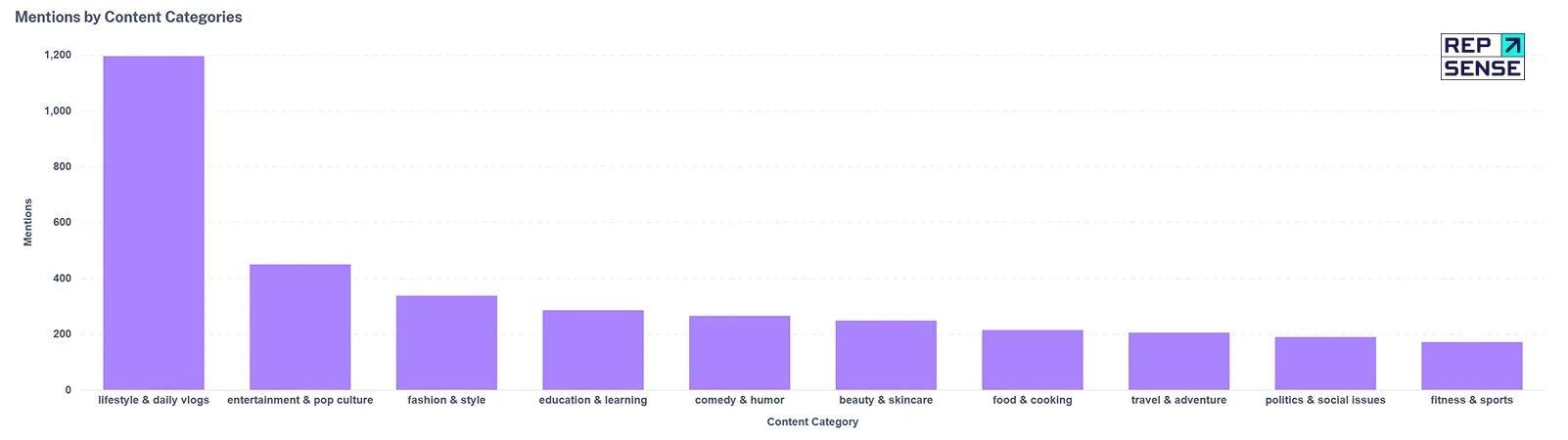
As you can see from the charts for the past 50 days, the answer is clear - TikTok.
On Instagram, there is generally very little political content, or it tends not to gain much popularity (the exception being highly active pro-Palestinian content). On YouTube, there is a lot of political content, but “vatnik” [a Lithuanian colloquial term describing individuals supportive of pro-Russian political narratives] content there does not attract many views. The anti-system niche (though usually not pro-Russian) is occupied by figures actively involved in Lithuanian political life - channels such as OpTV, Kitaip TV, and similar platforms, as well as projects represented by Arnas Klivečka and Artūras Orlauskas [ Lithuanian anti-establishment, ‘fifth column’ public figures].
They are counterbalanced by right-leaning podcasts and internet TV broadcasts (there are very few social democrats, democrats, or other Lithuanian centrists in this space). Meanwhile, on TikTok - with the exception of the popular political scientist Linas Kojala - the main “political news menu” is dominated by various kinds of fringe figures.
3. What does the Russian propoganda entail?
So, there are two types of propaganda profiles.
The faces of the authentic “vatniks” are well known. Most of them emerged during the period between COVID-19 and Russia’s invasion of Ukraine and have since appeared across virtually every possible platform. They usually do not hide their identities, their faces, or even their cars (next to which they often record their speeches). The atmosphere of freedom on TikTok - and the supportive comments (often coming from semi-automated bots) - encourages them to speak without much self-censorship.
“Videomania” (if such a term exists) seems to affect some of them: Darius Augustinavičius posts constantly; Lobovas claims to offer cures for cancer; Driskius and Tutkus proudly embrace the label of “vatnik” (the former even says that vatniks stand for life, while “Russophobes” stand for death); the now-removed SOBR account once called for confrontation with riflemen allegedly monitoring his home. Stanislavas Tomas proudly displays the Soviet Union flag in the background of his videos (which, incidentally, appears to carry criminal liability under Lithuanian law).
When such ideologically driven anti-system figures do hide their faces, they are still relatively easy to identify. Their transition from text-based platforms to video platforms allows them to reach a significantly wider audience.
Here are a few typical examples:
In the video, filmed in the Port of Klaipėda or its vicinity, a body of water with ships and tugboats is visible. The screen displays the text “Soon we will welcome Russian ships in the Port of Klaipėda”, accompanied by the Lithuanian and Russian flags and heart emojis, implying support for Russia. In the background, the well-known Soviet wartime song “The Sacred War” is playing, which is often used today in pro-Kremlin propaganda. This content clearly promotes a pro-Russian narrative that contradicts Lithuania’s official state position and is considered disinformation and agitation.
Objects detected: ships, Lithuanian flag, Russian flag, heart emoji, smiling face emoji, grey color, blue color, red color, green color, yellow color.
In the video, a man sitting on a black leather sofa responds to a hateful comment wishing death upon his family’s graves. He contrasts “vatniks” (pro-Russian individuals) with “Russophobes,” claiming that the former wish for life while the latter wish for death. The man emphasizes the concept of karma, stating that everyone will eventually answer for their wishes, desires, and curses, and that good will ultimately prevail over evil. He also insultingly refers to the commenter as a “stupid Ukrainian woman,” expressing pity for her family. The content appears intended to counter online hate, while simultaneously employing offensive language.
Objects detected: glasses, glass containers, black leather sofa, shelves.
In this personal opinion video, filmed outdoors at night, a man expresses strong criticism of Lithuania’s elite and journalists, calling them “pseudo-patriots” and comparing them to lapdogs. He claims that the elite themselves provoked confrontation with the governments of Russia and Belarus, and are now afraid of potential military aggression. The speaker calls for seeking compromises in order to avoid war and “mass killings,” and describes the current situation as “complete madness.” The video also contains vulgar language.
Objects / attributes detected: anger, criticism, black color, white color, speech, vulgar expressions, misinformation, misleading narrative, politics & social issues.
In the video, lawyer Stanislovas Tomas criticizes Lithuania’s democratic processes and the actions of the Central Electoral Commission (CEC). He claims that Lithuania is not a democratic state where free expression is possible, comparing the situation to a one-party system like Vietnam and illustrating this with communist symbols. Tomas discusses the CEC’s decision to bar three candidates, including Edikas, from participating in the elections, arguing that this restricts freedom of speech. He emphasizes the need to appeal such decisions to international courts and addresses potential limitations on candidates due to the origin of their funds.
Objects / entities detected: Stanislovas Tomas, Central Electoral Commission, Dalia Grybauskaitė, Grybošenko, Lithuanian Supreme Administrative Court, United Nations, European Court of Human Rights (Strasbourg), hammer and sickle, Vietnam flag, Europe, Russia, China, Donald Trump.
Catching these videos is actually quite easy. Some “vatniks” just speak whatever comes to mind, others repeat current Russian narratives, and some put in more effort and research. But for nearly all of them, the driving force is reactions and views. Without the algorithmic push of content distribution, you could treat them like a kind of digital “reserve,” but analysis shows that their content reaches a far wider audience than just their hardcore like-minded followers. To maintain their audience, these Kremlin enthusiasts also post broader anti-elite content - anti-vaccine, general political, and social criticism - thereby integrating into the broader flow of Lithuanian political content. A key part of Romanian candidate Georgescu’s TikTok campaign, for example, was boosted by non-political anti-system accounts that started posting his content and quickly merged into a wider anti-European segment of the Romanian electorate.
The second type of vatnik profile is much cleverer and more interesting. Successful pages like “newsblackcat” or “policyoftruth” slip through TikTok’s standard filters more easily. I suspect they use automated monitoring from some internet research agency focused on the Lithuanian public sphere to identify suitable narratives. Lithuanian or Russian curators then supplement this with their own input. Once the clips are identified and coordinated with the curators (some clips appear with significant delay), they typically follow a pattern:
Take a clip, for example of Laurynas Kasčiūnas speaking on his podcast (recently, his popularity among vatniks even rivals the widely disliked Lithuanian Minister of Defense, Dovilė Šakalienė), or show a segment from a TV news broadcast or publication.
Add contextual media that reinforces the propagandistic message - for instance, ominous or comedic music, voices from popular Soviet films, bold text, or simply a GIF or emoji. The supplemental media often contrasts with the primary message.
During the clip, they use simple techniques to create a sense of drama.
The effect is strange and inconsistent. Many clips are subtle - “blink-and-you-miss-it” style, where viewers are meant to understand what’s wrong or humorous without it being spelled out. Subtlety seems to attract a new audience and may even fool the algorithms (sometimes real users, misunderstanding the irony, end up commenting by mistake). Other clips are blunt, with the message written directly on the video. Consistency is impossible to expect - it seems different people work in the troll “factory,” or the algorithms themselves are being tested.
The main goal is to provoke comments that create the right context for the video and encourage further dissemination.
Some comments are undoubtedly generated automatically, but unfortunately, real user profiles also participate. View counts vary - the most successful clips can reach hundreds of thousands of viewers.
In practice, it looks something like this:
The apparent purpose of the video is to inform about a potential threat or military activity near the border.
Objects / attributes detected: alarming, green, brown, gray, military activity, politics & social issues.
In this artificially generated video, a purported conversation between Volodymyr Zelensky and Donald Trump is depicted, in which Zelensky’s voice is used to speak offensively and vulgarly. The content is propagandistic and disinformative, intended to discredit the Ukrainian president by presenting a distorted narrative of alleged disputes and threats. Its obvious purpose is to incite hatred and spread false information.
Objects / attributes detected: deepfake, false claims about Zelensky, vulgar language, threatening speech, derogatory language, offensive ethnic epithets, harmful content, propagandistic content.
And here, podcaster Skirmantas Malinauskas was clipped and taken out of context:
In this video, a man wearing Chicago Bulls shirts discusses support for Ukraine. He provocatively asks whether we are ready to pay for someone to die on our behalf, framing it as his mercantile perspective on aid to Ukraine. The apparent purpose of the video is to encourage reflection on the meaning of support, but the chosen rhetoric can be misleading and may potentially discourage public willingness to support Ukraine. The speaker states that he previously transported aid himself but has now stopped, while expressing respect for those who continue to collect and deliver assistance.
Objects detected: Chicago, glass, man.
Similar bots are not unique to Lithuania - quite the opposite. We are currently monitoring elections in Moldova, where enormous Russian propaganda resources and money are being deployed against President Maia Sandu’s party. There, too, most content is generated by various semi-anonymous “curated news” accounts monitoring opponents in the public sphere. These accounts are sometimes linked to local political actors, but more often react opportunistically to current events.
As election day approaches, all subtlety disappears - the “curated” accounts spread obvious fake news about the country’s president: claims that she was treated in a mental hospital, that she changed her gender, that she is imposing a dictatorship, or that she is preparing the country for occupation from Romania and Odesa.
Is everything this bad? There are a few bright spots: the bold and witty Dominykas Kubilius channel counters vatnik content, and several anonymous channels repost anti-Russian propaganda. The popularity and view counts of political scientist Linas Kojala’s channel show that TikTok has a large audience that actively watches and engages with political content.
However, given how the TikTok algorithm works, it is easy to imagine the impact this propaganda has on young people’s political beliefs and how it shapes public opinion on strategically important issues.
4. Why does this matter, and what is the overall effect?
In my post last week, I already explained why TikTok is so important:
Here are a few more numbers I found from different sources:
Adult reach (18+) in Lithuania: 40%
By gender: Women 52.7%, Men 47.3%
Age group 18–24: 60.5%
Of all internet users in Lithuania: 54%
And a few global facts:
Reuters Institute 2024: Social media video platforms in the U.S. surpassed television for the first time — 54% of Americans get their news from social media, compared with 50% from TV.
World Economic Forum (WEF): From 4% in 2015 to ~34% in 2025 of people report that social media is their main news source.
Youth worldwide: 44% consider social media their primary news source.
Short videos now dominate social media, overtaking texts, short posts, and blogs.
5. What should we do about this?
To put it bluntly, the situation is as follows:
Lithuanian civil servants do not have accounts on the most politically active network - TikTok - because it’s prohibited.
Even monitoring is banned, so Lithuanian TikTok is largely a source of myths and folklore, or just what kids happen to post.
Lithuanian politicians follow the civil servants’ lead - you won’t find accounts for either right-wing or mainstream systemic politicians.
Information goes unmonitored and unchecked. While the propaganda hasn’t yet reached Moldova-level intensity, it is still happening.
A very dangerous radicalization process is underway - vatniks and possibly Russian-curated accounts are radicalizing the broader anti-systemic or apolitical Lithuanian electorate. This inevitably spreads to other social media platforms and influences the behavior and views of anti-systemic politicians themselves.
And it’s not just anti-systemic voters. If the research is correct (and it is), more and more young and older people are turning to TikTok for news and information, instead of Google or Delfi searches.
Right now is not an election period. But if the Moldova example tells us anything, it’s that many of these subtle accounts will switch to spreading radical lies and hate as elections approach.
Possible responses:
Ban TikTok. Linas Idzelis, head of the Lithuanian Riflemen’s Union, says TikTok should simply be banned. I agree that this is a potential solution. Three caveats:
I don’t see the political will to do this, and the legal aspects are questionable.
Public outrage would be significant, which is exactly the type of event where vatniks like to target voters who are less politically engaged.
Radical users accustomed to algorithm-driven content will find other ways to get their fix - some will turn to Instagram, but many will use VPNs or other, less-monitored platforms.
Decolonization / content cleaning. As recent RRT decisions show, you can clean selectively, even one at a time. The TikTok vatnik network is already complaining that some of their videos are blocked. There aren’t that many vatniks, and making new content popular takes time. As a community, we have good experience cleaning Facebook (except for hard-to-track local groups, which is a matter for the state). There are also plenty of content creators - most of the popular TikTok creators are normal, healthy-thinking influencers, not vatniks. I fully understand the risks, but the 10:1 ratio on a platform that reaches nearly half of Lithuania is unacceptable. It is important to understand that monitoring obscure sites or moderating comments is trivial compared to the views generated by anti-state, pro-Russian, or at best anti-Ukrainian content.
Worst-case scenario: do nothing, monitor nothing, understand nothing.
And do nothing.
Repsense is growing quickly. We work across the public sphere of six countries, collaborating with NATO member state governments, EU institutions, private companies, and non-governmental organizations. When time allows, we also run free projects like this one.
Are you a curious, organized, and experienced data analyst? Read this job posting! It’s unlikely you’ll find a more interesting opportunity — we do work that matters to society, use and develop cutting-edge technologies, and have a team of professionals who have accomplished a lot on the global stage. We are friendly and results-oriented.
https://www.linkedin.com/company/repsense/
If you’re interested in our services - or want to join our work - write to us here:
connect@repsense.io